Hevruta - Following Lesson 26 - The structure of the upper worlds
Structure of the Upper World Following Lesson 26 We will read through the text of Baal HaSulam and then the explanation of Rav. There are a lot of words and concepts that can be hard to remember. For now we …
Structure of the Upper World
Following Lesson 26
We will read through the text of Baal HaSulam and then the explanation of Rav.
There are a lot of words and concepts that can be hard to remember. For now we only want to get used to used to it, and try to see how much we can not just understand but also feel what this is talking about.
Next Sunday we will move to a different kind of materials altogether - where it will be easier to grasp - but for now let's try to do our best to see what Baal HaSulam is trying to explain us about our the desire to receive can establish a connection with the upper force.
Baal HaSulam:
26) We clearly understand the notion of the Masach (screen), placed over the Kli Malchut (Behina Dalet) after TA, and also the five kinds of Zivugey de Haka’a that occur on this screen to create five levels of 10 Sefirot, one beneath the other. Now we shall learn about the five Partzufim of the world of Adam Kadmon (AK) that precedes the four worlds of ABYA.
We know that the Ohr Hozer that rises as a result of the Zivug de Haka’a dresses the 10 Sefirot of the Upper Light; this is sufficient only to create “the roots” of the future Kelim defined as the 10 Sefirot de Rosh.
Malchut spreads from up downwards, according to the height of the level of the 10 Sefirot de Rosh. It results in the creation of the Kelim called “Guf” (body) of the Partzuf (see §14). Therefore, there are always two kinds of the 10 Sefirot in the Partzuf: the Rosh and the Guf.
In each Partzuf, two kinds of the 10 Sefirot should be determined: the Rosh and the Guf. Those who do not know Hebrew find it much easier to study Kabbalah, because they do not take literally such Kabbalistic terms as Peh-mouth, Rosh-head, Guf-body, Tabur-navel etc. They can understand them abstractedly, and such people do not make a materialistic picture out of these terms.
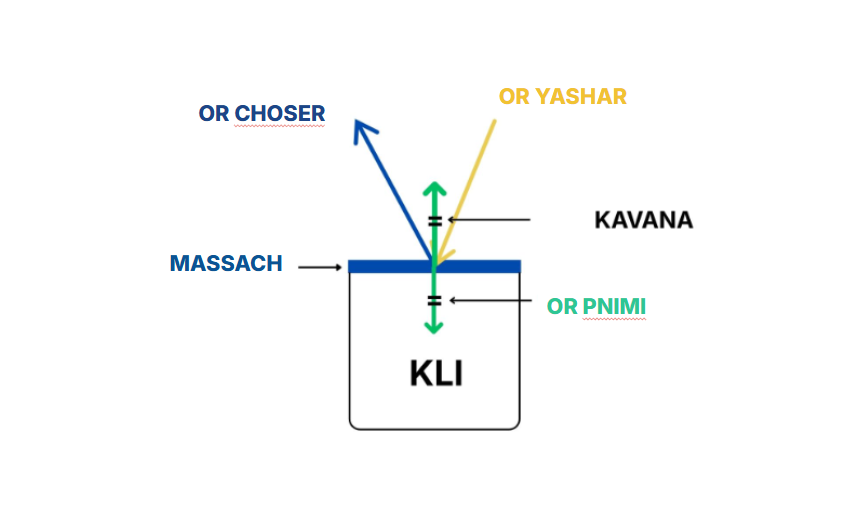
The place where the reflecting Masach resides is called the Peh. At first, the Masach pushes away all the Ohr Yashar that is before it, as if to say it does not want to receive anything for its own sake. Then a calculation is made in the Rosh to determine how much can be received anyway, not for its own sake, but for the sake of the Creator. Then, the Ohr Hozer dresses the 10 Sefirot of the Upper Light (de Ohr Elion) from down upwards.
It is sufficient only for making a clear decision; the vessel roots (Shorshey Kelim). The 10 Sefirot of the Reflected Light that dress the 10 Sefirot of the Direct Light together form the 10 Sefirot of the Rosh of the Partzuf.
To complete the formation of the Kelim and truly receive the light, the 10 Sefirot de Ohr Yashar dress into the 10 Sefirot de Ohr Hozer. They “pass” through the Masach, spread from up downwards, thus widening the tenth Sefira of the Rosh - Malchut de Rosh for its own 10 Sefirot - from Keter to Hochma and forming the Kelim de Guf .
Before Malchut could receive for the sake of the Creator, it was compressed, restricted to the size of a point. Nevertheless, by receiving the screen, it acquired a new intention to receive for the sake of the Creator, and then it “expanded” from a point to the 10 Sefirot, receiving the light into the Guf.
27) As soon as the first Partzuf of the world of Adam Kadmon is born, after TA, Behina Dalet immediately stopped being a Kli for receiving the Upper Light, being thus corrected by way of the screen. The Upper Light descended to be dressed in the Kli Malchut according to its nature.
However, the screen, which positioned itself before Malchut, reflected and returned it to the Source. Because of this Stroke Contact, the Ohr Hozer ascended to the level of Keter de Ohr Elion. This Ohr Hozer has become the embryo of the vessels (“the Shorshey Kelim”) for the 10 Sefirot de Rosh of the first Partzuf of Adam Kadmon.
Afterwards, by using the power of the 10 Sefirot de Rosh, Malchut de Rosh together with Ohr Hozer expanded and spread from up downwards, thus creating inside itself 10 new Sefirot, which are true and complete Kelim. All that potentially existed in the Rosh has finally manifested and taken form in the Guf. Thus, the creation of the Rosh and the Guf of the first Partzuf of the world Adam Kadmon was completed.
After TA, when Malchut made a restriction on reception of the light, it decided to receive a portion of it with the help of the screen for the sake of the Creator. The first reception formed the first Partzuf of the world of Adam Kadmon (Keter or Galgalta). Overall, there are five Partzufim in the world of Adam Kadmon.
The Masach in the Kli Malchut pushed away the entire Upper Light. With the help of a stroke (Haka’a) into the Masach, whose force was equal to all five Behinot, the Reflected Light (the Ohr Hozer) rose to the level of Keter of the Direct Light (the Ohr Yashar) and dressed the 10 Sefirot de Rosh of the first Partzuf of AK. Then Malchut expanded, and the light spread inside it, forming the 10 Sefirot de Guf.
The part of the Kli (Guf), which was filled with the light, is called the Toch (the inner part), and the light in it is called “the Ohr Pnimi” – the Inner Light. The part of the Guf that remained empty is called the Sof (end), and the light in it is called the Ohr Hassadim.
This part refuses to receive any pleasure, because it does not have a proper screen; so if it receives the light, this will lead to the reception of pleasure for its own sake. The boundary separating the Toch and the Sof is called the Tabur (navel). The light that has not entered the Kli is called the Ohr Makif (the Surrounding Light).
Each Partzuf sees what light is in front of it only with the help of the Reflected Light. If the power of the Reflected Light equals the power of the screen on all five Behinot, it can see the light of Keter. It divides this light into five parts, fills the Toch with them, leaving the Sof empty. Light of any intensity can shine in the Rosh of Partzuf, but Malchut de Peh de Rosh will see only as much as the Ohr Hozer allows it to.
Our senses are based on the same principle. Make them more sensitive and they will see micron-sized objects, feel microbes etc. In other words, everything depends not on what really surrounds us, but on whatever we are able to detect, on the perceptibility of our sensors.
Each subsequent Partzuf has a screen of a smaller quantity and quality of desires (Behinot) than the preceding one; therefore, its Ohr Hozer is smaller and it sees the light of a lower level. It resembles a person whose eyesight has deteriorated and who can see objects only at a short distance.
If the screen has the strength of the Behina Gimel, it can see the light of the level of Hochma as regards the preceding Partzuf. Regarding itself, it receives the same five parts of the light of NaRaNHaY, but of the general level of Hochma, not Keter. Let us take the example of this world: a tall person and a short one naturally consist of the same “parts”. However, we say that one of them is a whole head taller than the other, i.e., the latter is, as it were, short by a head.
We study the descending worlds. When the Universe came into being, the Partzuf Adam HaRishon (the First Man) was created. Then this Partzuf split into 600,000 fragments called souls. Each of these fragments has to receive its part of the Upper Light.
When the soul, i.e., a fragment of the Partzuf Adam HaRishon, reaches a certain level in the spiritual world, it receives a little of its part of the light. Although it has not yet received the entire light assigned to it, the soul perceives this state as absolutely perfect. Then a little more egoism is added to it (the soul) and again it begins to wish for more. By correcting this portion of egoism, it receives a new portion of the light in the newly corrected vessels, and only then realizes that there is a greater perfection to be attained.
If a man lacks this inner desire, the need or point in his heart, he is unable to understand how one can be interested in spirituality. By the way, fortune telling, amulets, alternative medicine and blessings have nothing to do with spirituality. Kabbalah interprets the spiritual as the aspiration for the Creator, His properties. In fact, we always discover that whatever seemed supernatural to us turns out to be the work of more or less talented frauds who use the forces of our world unknown to most people, as well as psychology and the inner powers of the human body.
29) So we have investigated the formation of the five Partzufim of the world of Adam Kadmon called Galgalta, AB, SAG, MA and BON, where each subsequent Partzuf is one step lower than the preceding one. For example, there is no light of Yechida in the Partzuf AB, and no light of Haya in SAG (it was in AB). The light of Neshama is absent in the Partzuf MA. The level of each Partzuf depends on the thickness of the screen on which a Zivug de Haka’a is made (see p.18). However, we have not yet clarified the reason for the lessening of the screen’s thickness at the formation of a new Partzuf.
After TA Malchut acquires a screen with five degrees of hardness, hence it can work with all five levels of its desires. Using the screen’s force, it reflects the entire light and in the Reflected Light reaches the level of Keter. It “sees” all five parts of the coming light: the lights in the Sefirot Keter, Hochma, Bina, Tifferet, and Malchut, which are in the Rosh. Approximately 20% of each light can be received in the Toch.
The general level of this light is determined according to the highest light – Yechida, which corresponds to the level of Keter (Komat Keter). In the second Partzuf, Malchut can receive less light, since it loses one higher level of desire – the Aviut Dalet and the light Yechida.
The amount of light in the third, fourth and fifth Partzufim is even smaller. Their level gets lower and lower because of the decreasing Aviut that occurs from Gimel to Bet in the third Partzuf, from Bet to Alef in the fourth and from Alef to Shoresh in the fifth. According to the degree of Aviut, there are no lights Yechida and Haya in the third Partzuf SAG, Yechida, Haya and Neshama – in the fourth and Yechida, Haya, Neshama and Ruach – in the fifth .
The Partzufim look this way only as regards one another, where each Partzuf that follows is “one head” lower than the preceding one by the level of the light, strength, and quality. However, each of them has its own 5 (or 10, as is known Sefira Tifferet consists of 6 Sefirot) Sefirot KaHaB-TuM and 5 lights NaRaNHaY, respectively.
Each Partzuf must have a set of all those 10 parts of which the creation consists. The Partzufim differ only by the strength of their screen. Therefore, when the screen grows weaker, a new Partzuf is born one-step lower than the preceding one.
After TA, the Kli consists of the 'desire to receive' and the Masach. The filling of the Kli happens in accordance with the strength and size of this Masach. The screen can push away the pleasures corresponding to its five, four, three, two, or one desires.
Our world is a reflection of the lowest spiritual world, and it has the same types and kinds of objects as in the spiritual world, except they are, as it were, made of a different substance. They consist of a material desire to receive pleasure without the screen, from the portion of light, completely detached from the Creator. We feel it as pleasure, but we do not feel its source. Therefore, by studying the spiritual world, one can completely attain the entire nature of our world, all its laws.
Complete (or start) with lesson from Rav Laitman:
https://kabbalah.academy/en/videos/5-olamot-de-ak-rav/