"Hevruta" - following Lesson 25
Masach, Orh Hozer, Ohr Pnimi
The Structure of the Worlds First we will refresh our intention with a few quotes from the Kabbalist about the intention before the study. Then we will review the schema and the structure of the world from our lesson …
The Structure of the Worlds
First we will refresh our intention with a few quotes from the Kabbalist about the intention before the study.
Then we will review the schema and the structure of the world from our lesson on Sunday
And the if we have time we have a short article of Rabash about Orh Hozer with some explanation of Rav Dr. Michael Laitman so we can try to internalise what we study also in our heart and not just in the head.
In spirituality, equivalence is called "adhesion", even though in action one receives. And this is called "receiving in order to bestow."
But how is it possible for there to be a state of equivalence of form? Since this desire to receive was created by the Creator, how can it be possible to cancel the nature of what the Creator created? For this, a correction was given: in truth, the nature of the will to receive cannot be canceled. Rather, an intention to bestow is added over it. Thus, the will to receive—meaning when a person sees something from which he can enjoy—remains. That is, even afterwards the person enjoys, only with a different intention. This is called "receiving in order to bestow."
(Rabash. Article 3 - 1990)
The lower can only add to the vessel of the Creator. And this is as it is written, "which God created to do," meaning, God created the vessel, which is called the "desire to receive pleasure." And the person must add to it a correction, called "the intention for the sake of bestowal," as above, that the Malchut of Ein Sof adorned herself with the point of desire, which means her adornment was in that she placed upon the desire to receive the intention for the sake of bestowal.
(Rabash. Article 22 - 1987)
If a person's intention is only to give pleasure to the Creator and not for his own benefit, then he pays no attention to the amount of pleasure. He looks only at the magnitude of the desire to delight the Creator. For by yearning to delight the Creator, he causes a form of equivalence at the root of his soul. And this causes an even greater abundance to be drawn, since the Upper one wants to give more than the lower one wishes to receive, only the lack is in bestowing vessels. Thus, by increasing his desire to bestow, great abundance flows to him. Therefore, one should not ask to have great Lights, but rather strive to have large vessels, which are vessels of bestowal.
(Rabash. Article 31 - 1988)
Accordingly, a person must strive to make a great effort, even before beginning to study, so that his learning will yield fruit and good results. That is, the learning will bring him the Light of the Torah, through which it will be possible to return him to good.
(Rabash. Article 12 "What Are Torah and Labor in the Path of the Creator" 1988)
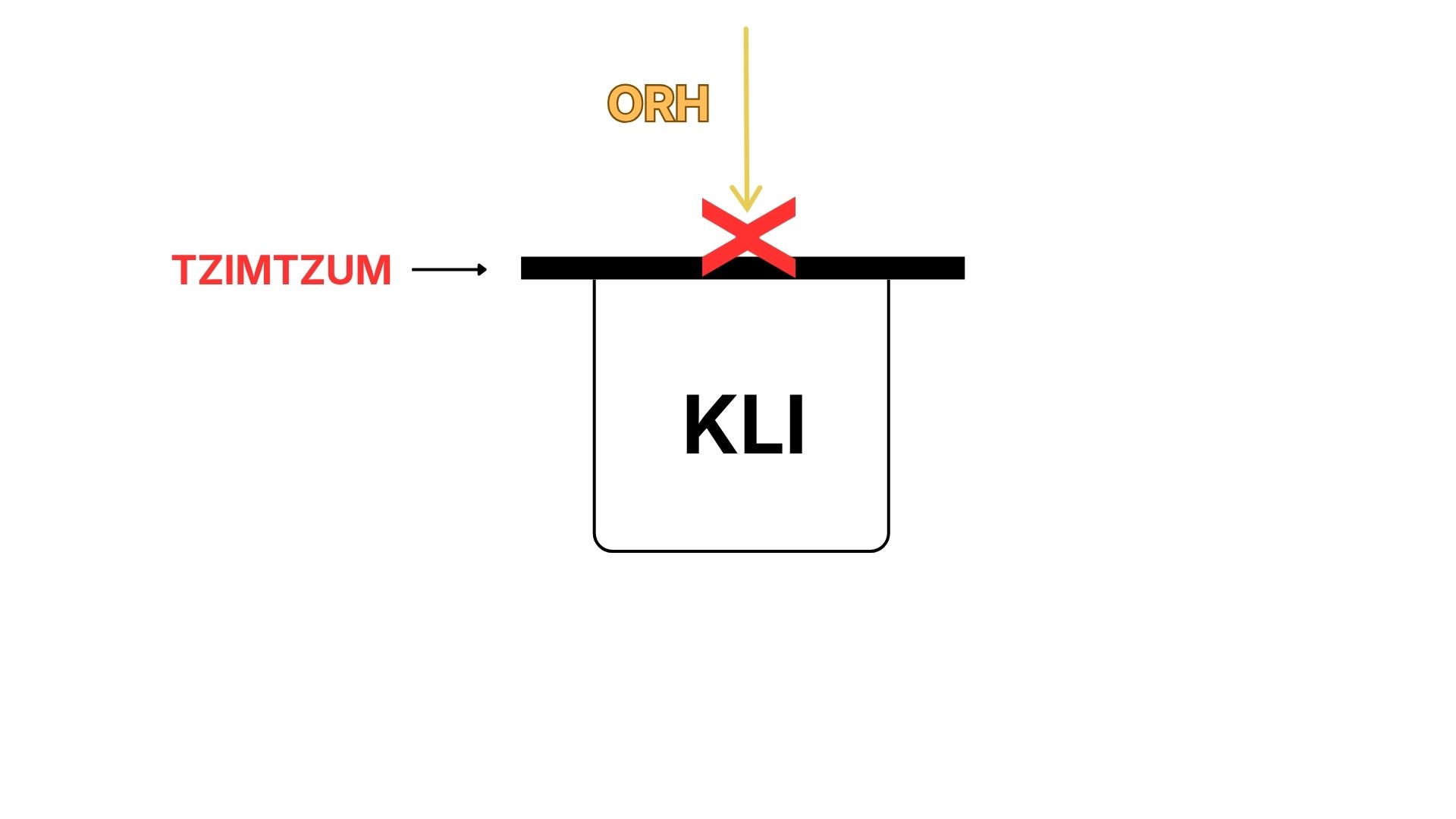
Orh : Light (what is felt in the kli)
Tzimtzum: Restriction
-
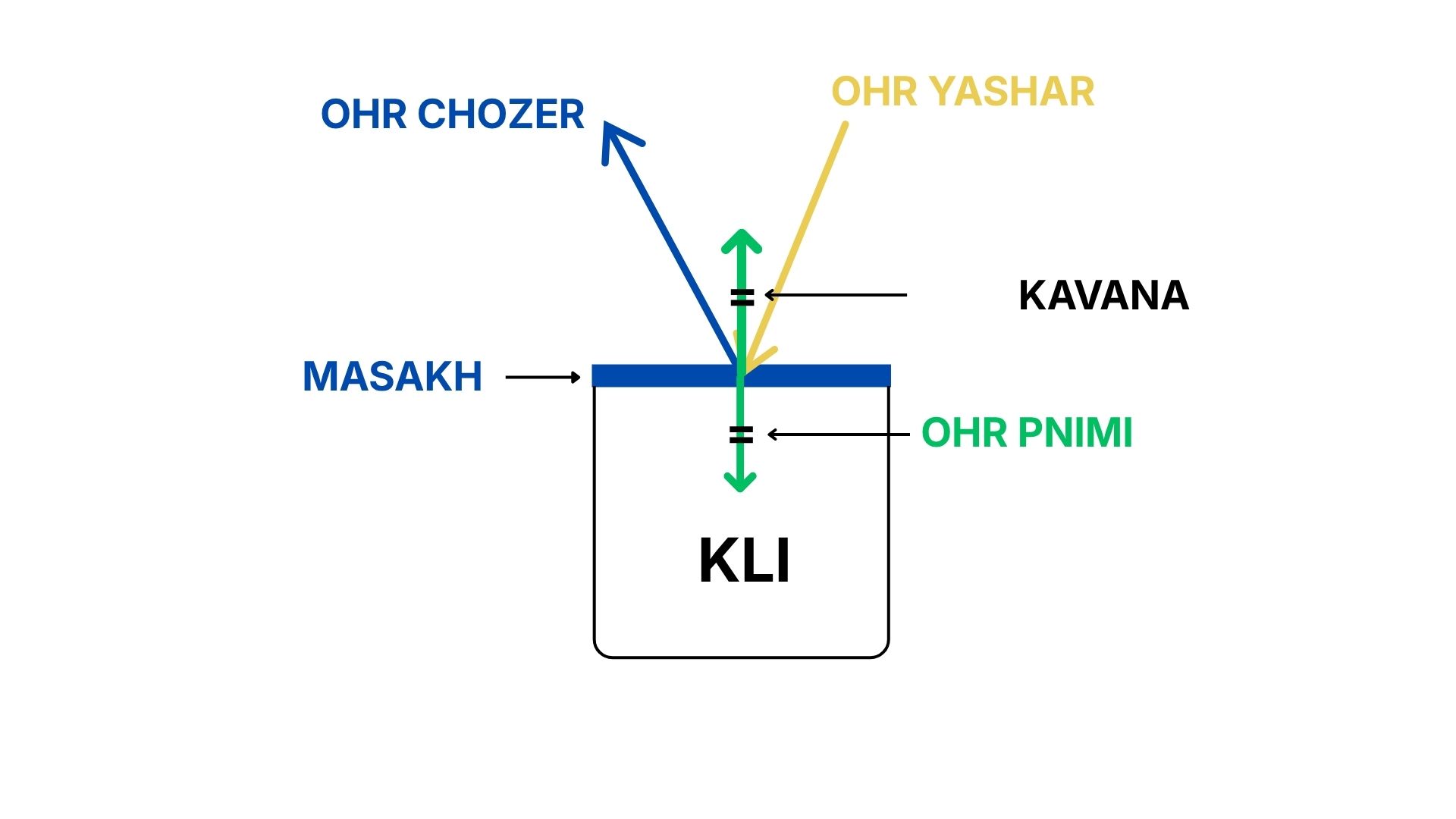
Masakh = the screen (blocks the light from entering egoistically - only with the intention)
Kavana = Intention (the intention to be like the creator, to bestow)
Orh Yashar = Direct Light (the pleasure the Creator wants to give to the Creature, and the creature wants to receive)
Ohr Hozer = Reflected Light (defined by the importance of the giver)
Ohr Pnimi = Inner Light - the pleasure that can be accepted only to the extent we have the intention / the importance of the giver)
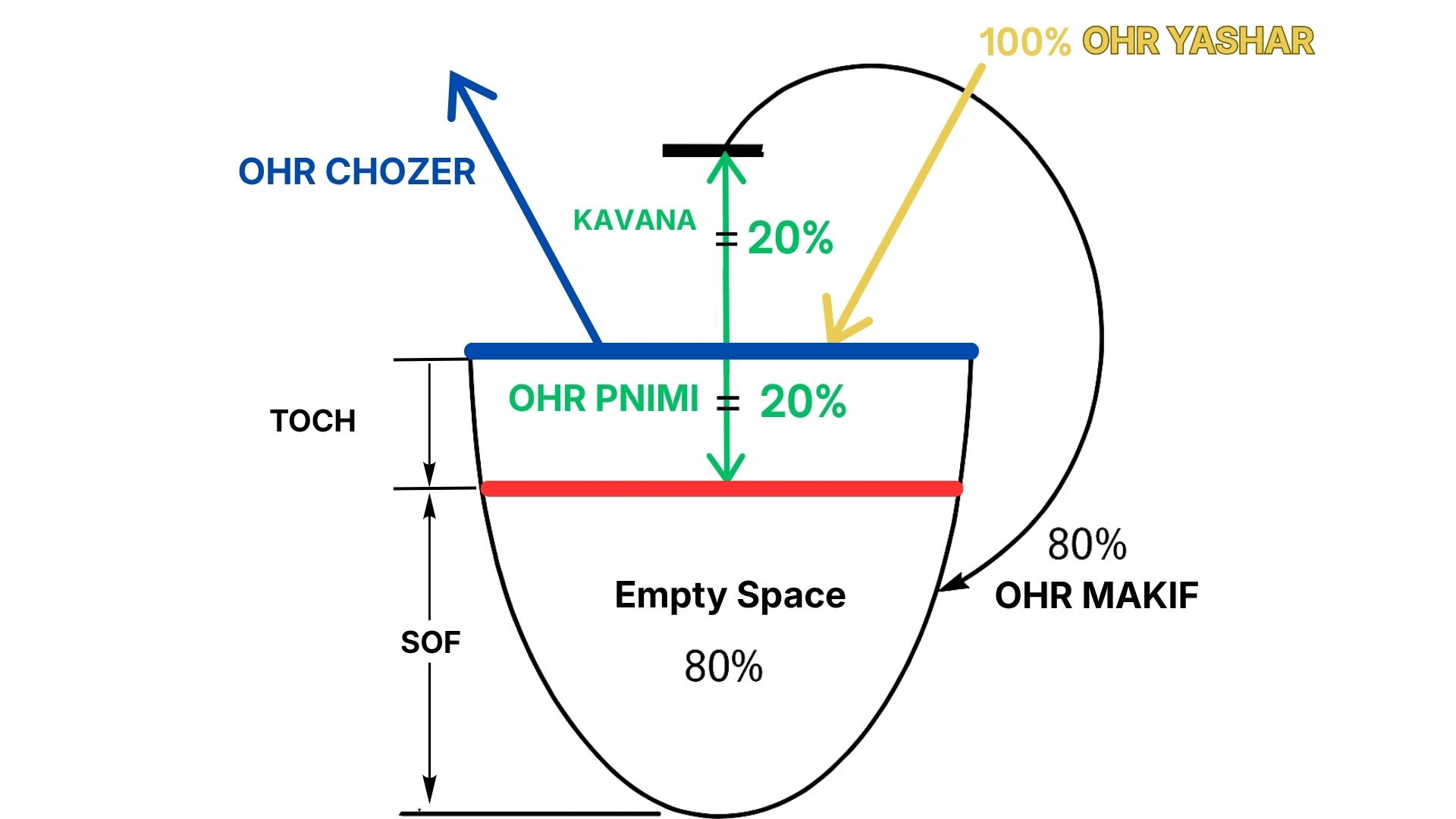
The evaluation made in the Rosh (head) determines how much can be received (Orh Pnimi)
What we cannot cover with our intention (Kavana) is not received; the place is left Empty
The surrounding Light (orh makif) is the light that the Creator wants to give but cannot because we do not have the proper intention. This Ohr Makif keeps pushing for the Kli to evolve and to change so it will be closer to the goal of the Creator,
Rabash - Dargot HaSulam 557 - About Orh Hozer
"In the study of the Ten Sefirot (p. 39, section 3, and Inner Light section 20) it is written that the Ohr Hozer rising from the screen upward is called attachment, because it holds and integrates the upper light in a circle, such that wherever the Ohr Hozer does not clothe the Upper Light, that light, for the created being, is as if it does not exist, because he cannot attain it without this garment called Ohr Hozer. Up to here is his words.
From this, we understand why not everyone feels Divinity, even though it is written, "I fill the heavens and the earth," and "The whole earth is full of His glory," and yet we do not feel anything.
The answer is as above: in a place where there is no garment called Ohr Hozer, the Upper Light is considered for the created being as if it does not exist. And since the whole purpose of the Ohr Hozer is to receive only according to the intention to bestow, therefore as long as a person is still in a state of receiving for himself, he does not have this Ohr Hozer. So, even though "the whole earth is full of His glory", nevertheless, for the lower one it is as if He does not exist.
It follows from this that a person has nothing to do to reach the goal except to focus all his efforts on one point: that he can devote all his free time only for the sake of Heaven. And this is the meaning of "everything is in the hands of Heaven except the awe of Heaven," meaning, everything is given by the Holy One Blessed be He.
That is, the Upper lights are already prepared for a person, and this is called, "more than the calf wants to suckle, the cow wants to nurse," and we only need to make the vessel. This vessel, after the tzimtzum, is called "screen and Ohr Hozer." This is what connects between the Upper and the lower; that is, through it the lower connects to the Upper.
But when this connector is missing, then the lower cannot see the Upper, and for the lower the Upper is as if He does not exist. Therefore, to the extent that a person begins to work for the sake of Heaven, to that extent he receives a connection with the Upper Light, and according to the magnitude of the connection so is the greatness of his attainment.
To understand the matter of AHP of the Upper, which fell into the GE of the lower for the benefit of the lower. On the moral level, one can interpret that the matter of GE and AHP is a secret of smallness and greatness. The correction is that Hochma and Bina made for the sake of the children, "
Rav Laitman on the article:
So let's imagine that we live in a world and it seems to us that we are many, but I live in a world that is entirely found in an opposite quality from me, and I feel it only according to my own quality. Therefore, I imprint everything I am capable of perceiving in my own vessels, in my current form, and everything else except for me—still, vegetative, animate, speaking, which I imagine—is all mine, in me, in my traits, in the desire to receive, and all the rest I do not see at all, all of whom are in the desire to bestow.
So, if instead of the will to receive, I equip myself with Ohr Hozer (reflected light), then I will reveal the true reality. In this way, I only reveal my qualities. Hence, "whoever faults, faults with his own defect," which means that I only see my own nature in everything I can feel.
The question is: then, how can this method help me that I must love the other, if that "other" is revealed in my own egoistic desire? Why does the method, which is supposed to bring true vision, to see and feel true reality, require me to change my attitude toward what I now see, and what I see is but an imprint of my inner qualities?
What is special about the screen, through which Ohr Hozer is made, and by means of Ohr Hozer we see a reality that we cannot see with our usual senses? What does this Ohr Hozer add to us? How do we produce it?
The fact there is confusion and obscurity is very good. We just need to ask together for revelation and clarification. Our intellectual or psychological effort is nothing, it is like a baby wanting to do something that is certainly not in his power. We need to reach a demand out of this.
How do we produce Ohr Hozer, what is Ohr Hozer, how does it come, how do we hold on to it, must we constantly guard it to avoid losing it, what is the difference between seeing in the usual way and seeing with Ohr Hozer, which reveals to us like a new flashlight the new spiritual reality?
Try to answer emotionally, not Ohr Hozer, Ohr Yashar, screen, tzimtzum, rejection, reception, but emotionally. What is Ohr Hozer that I feel inside? That is, in my qualities—it is not as we draw the Kli, Masakh, Ohr Hozer, not schematically, but emotionally. It happens in me, in my mind, in my heart, in my feeling, in my attitude, in my senses.