Hevruta - Following Lesson 22 - The structure of the upper worlds - Part 2
The structure of the Upper World Word of intention from Rav Dr. Michael Laitman about the study Here it speaks about the system of connection corrected between us—how all the parts, the arms, and the systems operate within it, …
The structure of the Upper World
Word of intention from Rav Dr. Michael Laitman about the study
Here it speaks about the system of connection corrected between us—how all the parts, the arms, and the systems operate within it, and how the souls are corrected by this system.
There are two parts in creation. One part is the system of the worlds, which was established in order to carry out corrections. The second part is the system of the broken souls, which were shattered from one soul into many parts, and the system of the worlds must awaken them to correction.
The Light of Ein Sof that shines through the system of the worlds awakens the broken souls to eventually reach correction and helps them to be corrected. Because it descends through the worlds, through concealments, the Upper Light receives a form opposite to what it is in the souls. Therefore, when it reaches the souls, it is in such concealments and revelations that it awaken different states within the souls so that they may advance toward it.
We study how the Light of Ein Sof that shines through the worlds awakens the souls, and the souls accordingly begin to perform actions in order to reconnect to the one soul called "Malchut of Ein Sof." To the extent that the souls connect, they ascend through the degrees of the worlds, and the worlds turn from concealments into revelations. The souls are incorporated in the worlds each time at a higher degree according to their equivalence with the worlds.
The system of the worlds must conceal the Light of Ein Sof from the souls - each soul according to its measure, its degree, its character, and according to the progress it needs to make. All this is done within the system of the worlds. When the souls, within the system of the broken souls, join in connection between them, they become precisely adapted to the system of the worlds.
Here in the structure of the Creation, Baal HaSulam, and the Kabbalists in general, they do not explain to us what actually happens with the souls themselves. Rather, they mainly explain how the system of the worlds operates in order to awaken us. And from this, it will becomes clearer how we must act in order to correct ourselves.
Key concepts we have seen so far:
- The Thought of Creation:
to delight the created beings in accord with His abundant generosity
- His Essence: that we do not attain
- Light (Orh) and Vessel (Kli): The will to receive in the emanated being is called a vessel (Kli), and the abundance that it receives is called Light. The kli is lack, and Light is the fulfilment.
- The light of Ein Sof: The light in which there is no restriction - no sof - no end (end to the reception)
Now let's review the dynamic of the 4 phases explained by Rav Dr. Michael Laitman
The whole problem that we have is how to receive from above the Surrounding Light (Or Makif) so that it will create in us the intention to bestow.
The intention to bestow is called the quality of Bina. The intention to receive, to enjoy, is called the quality of Malchut.
Therefore, the Creator, in order to create the created being and bring it to its highest level, when He creates His created being, He creates the desire to enjoy - the first stage (Phase 1 - Hochma) - and fills it, and within the fullfilment he also places Himself, that is, His feeling. This way, the desire to enjoy also feels the One Who Fills it, and he fills it must become like the Filler - the source of fullfilment - that is, to bestow and not to receive.
Thus, we see that the Light acts upon the Kli and fills it, and changes it in quality, and otherwise, we ourselves will never be able to do anything, that is, the desire in us is created by the Light, and we are filled by the Light, and this desire is also changed by the Light.
What happens in the first stage?
By the Light, the desire is created—the desire to be filled with the Light. And then the Light fills this desire. This is the first phase, the first part in the first stage, its upper half.
And then within the Light, the quality of Keter is revealed.
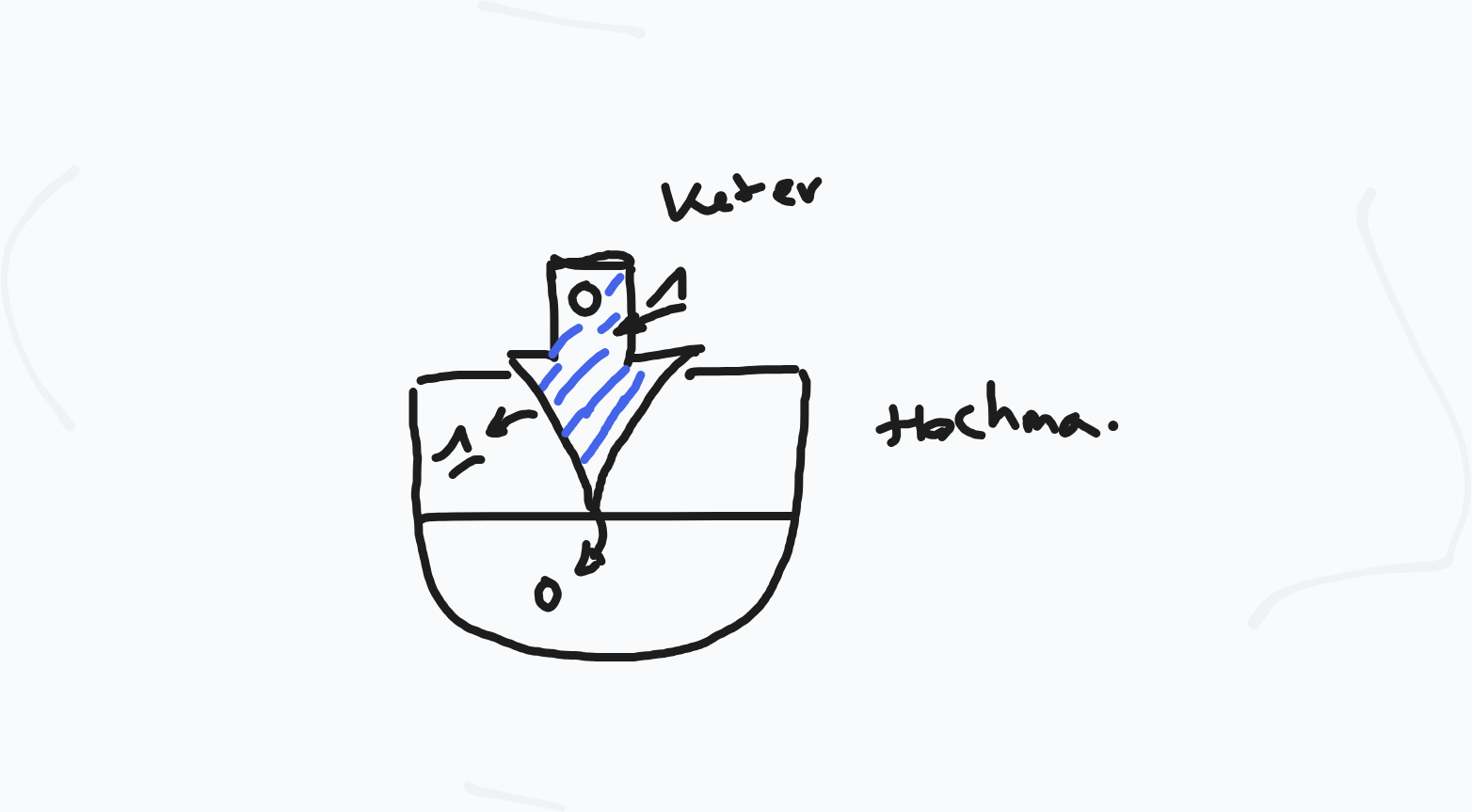
How does this happen? The Light comes from outside, it acts with pleasure—it enters the Kli and gives pleasure. And then within it, its zero stage, its zero quality, is revealed.
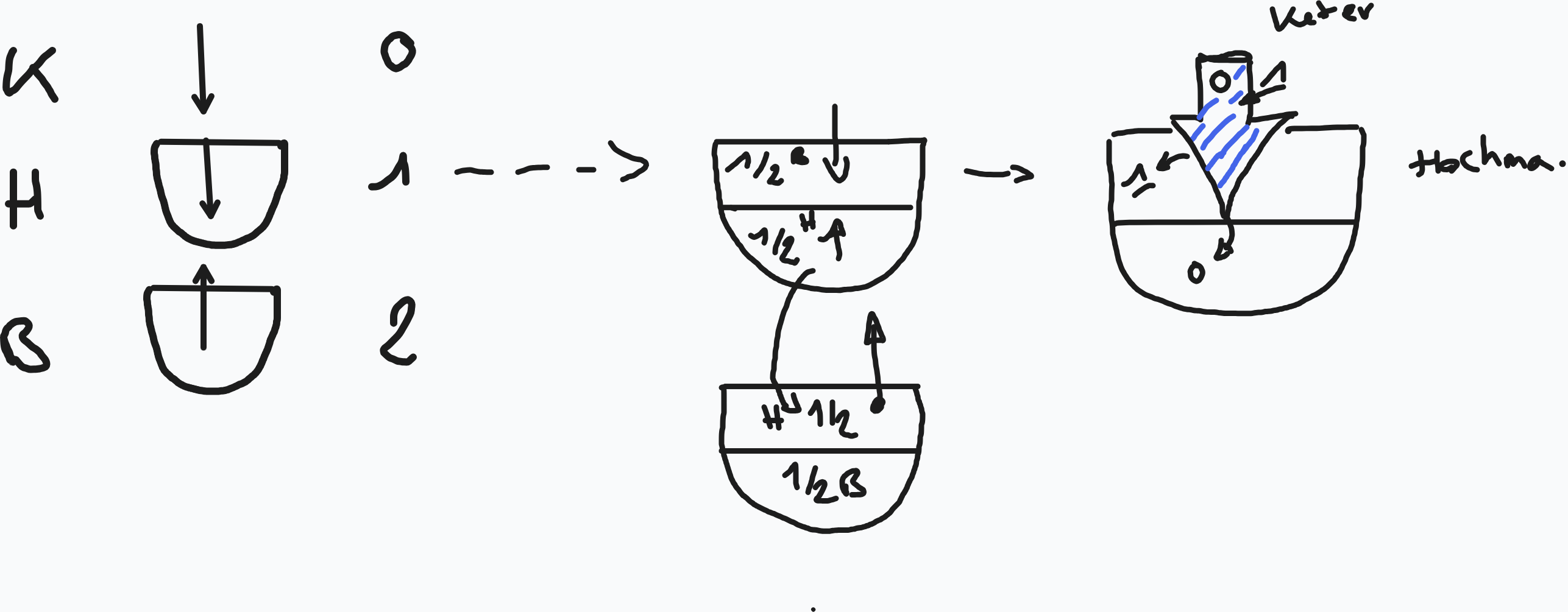
Inside this zero stage sits the Creator—the quality of the light itself. And here He gradually reveals Himself. First, the first stage is revealed, and then, when it enters the kli, the zero stage, which is higher, begins to be revealed. And the kli begins to want to always be similar to that which fills it. Therefore, in the desire to receive, in its next, lower part, the desire to bestow appears. And it is realized in phase 2 (Bina). That is, what is sent is always revealed first, and then its source.
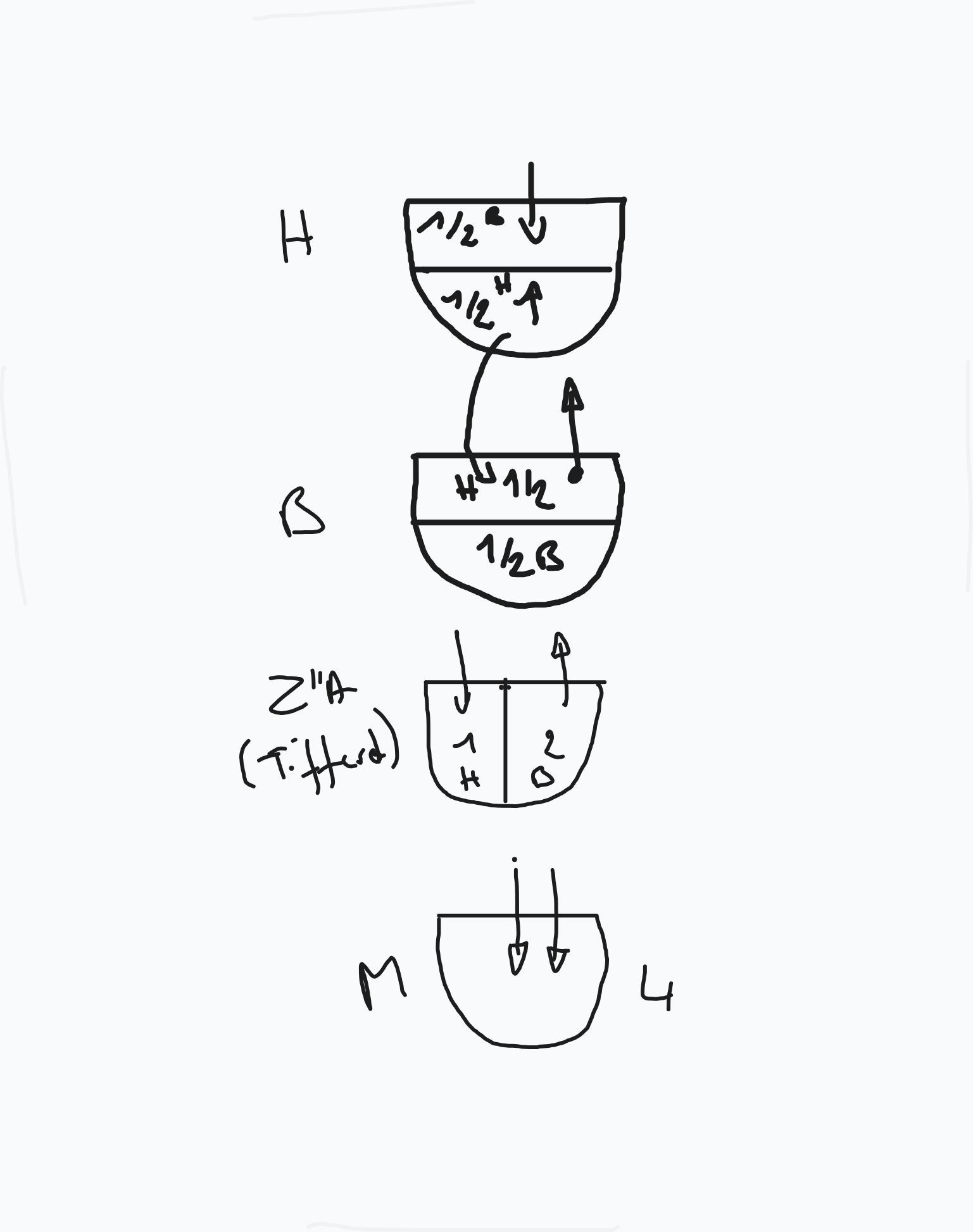
The same happens in desire number 2. In it, too, the desire to bestow is revealed, inside the desire to bestow. It comes from the first stage (within the desire to bestow is the desire to receive—the upper half). That is, first the lower half is revealed, and then within this lower half, its upper part is revealed. And therefore, Bina begins to understand that it needs to receive—the upper half is revealed. And so Bina consists of these two qualities: the desire to bestow and the desire to receive. The first creation, which consists of its own qualities and the qualities of the Creator.
Therefore, when a third part then appears—a mixture of the first and second parts inside, when Bina wants to receive in order to realize bestowal—by doing this, it begins to understand what the Creator is. By this, it becomes similar to the Creator. In Bina, it becomes similar to the Creator only in intention. And in the third part—in Zeir Anpin—it becomes similar to the Creator in action. That is, what does Bina do now? It receives, takes this first desire, and receives in order to bestow. That is, here there is, as it were, the first part—Hochma—and the second part—Bina. It realizes the desire to receive for the sake of bestowal.
And this action, in which she is completely similar to Keter, similar to the quality of the zero phase or Keter, this action causes within her the understanding of what it means to be the Creator. And therefore, within her arises the desire—not to receive, not to bestow, all this is nonsense—within her arises the desire to have the status of the Creator, to rise to His level.
The last phase, Malchut does not simply want to receive and enjoy, Malchut wants to receive, to enjoy, and to be equal in status to the Creator. This desire did not pass from the Creator to the created being in a direct way. It was born in the created being when the created being became similar to the Creator and understood what this means.
That is, this desire in Malchut—it is independent, not arising within her (Malchut) in a direct way from the Creator. Therefore, Malchut is called the created being, a desire that did not exist before. And it appears not due to the Creator, but as something that exists independently. If it had come from the Creator in a direct way, like Hochma or Bina, then we would not call this the created being. It would simply be a system that exists, created by the Creator and thus automatically activated by Him. But this is not so.
In Malchut, such desires appear that did not exist, that were not created in a direct way from the Creator along the path of the direct light. Therefore, these four phases: 0, 1, 2, 3, are called the four phases of direct light, direct influence from the Creator.
And this phase, Malchut, is no longer in these four phases. It is their consequence, correctly, but an indirect consequence, and therefore this desire in Malchut—it is new, coming from within the created being itself.
The created being wanted to be equal, completely similar to the Creator. In what? In being similar to Him in action—receiving in order to bestow. Receiving in order to bestow is equivalent to bestowal, it is equivalent to the root phase, the zero phase. Malchut understood what it means to bestow, and from this she also understood what it means to be the One Who bestows, what He experiences.
That is, if we divide the third phase, we will also see two halves in it. One of the halves is 1 and 2 for the first phase, the action of receiving for the Creator, that which was conceived in Bina, as Rosh, as the head in Zeir Anpin—it is performed automatically, that is, the performance of receiving for the Creator. And in the lower part, in the second part of Zeir Anpin—there occurs the realization: who, then, is the Creator, if He acts in this way? And from this arises the desire of Malchut to be similar to the Creator.
What does it mean to be similar to the Creator? To be similar to the upper part of Keter. That is, Malchut—she desires to rise to this level. This is called striving toward its Source. Not just toward the light, which acts, which satisfies the desires, but toward the Source of this light.
From all this we see that the light—it fills us, corrects us, brings us to everything, even to the highest result, even to its Source. That is, the influence of the light on Malchut, on egoism, happens in such a way that the light raises the created being above itself, above the light.
Question: The new qualities of Malchut, you said, are an independent desire. But in the initial thought of the Creator, the independence of Malchut is still embedded and comes from the Creator, and not from Malchut, is that correct?
Independence is called such an action on the part of the created being, which initially does not exist in it, which it acquires as a result of its own efforts. That is, the question sounds like this: and if Malchut will strive for something else, will it acquire this something else? No. There is in us only one single possibility—to strive toward the Purpose of creation or not. That is, in this regard, there is no freedom of will.
Do I have the freedom of will to remove myself entirely from this whole movement forward toward the Purpose of creation or not? There is no freedom of will to avoid this—they will drive you with a stick toward happiness. There is nowhere to escape, neither I, nor you, nor all humanity. All the suffering, especially now, in our time—they will manifest clearly, and they descend only for this.
That is, freedom of will is not in the aspect in which you ask: “Is there or is there not?” Not in how to go or where to go. Freedom of will is only in whether I will strive myself toward the Purpose faster than I will be driven from behind with a stick. Will I wait until they start beating me until I become wiser, or will I still strive myself (again, myself) toward the same Purpose? In any case, I will be forced, either voluntarily—that is, with the help of the group, so that I put myself under such advertising of self-persuasion or persuasion with the help of the group—to quickly strive for what is necessary, or I will wait until they beat me until I become wiser and still create a group around myself, and so on, and still not strive for what is necessary.
That is, everything depends on the time of idleness. If you do not want, you will stand a little longer—you will receive a few more blows, if not—less. The blows can be catastrophic, terrible: destruction, deaths, epidemics, whatever you want.
Or, on the contrary, the faster you strive forward and outpace these blows of nature, which pushes us toward this through suffering, the more comfortable you feel, the better, and you go through the same stages in a state of inspiration, elevation, a feeling of fulfillment, because you desire the next state. When you desire it and you receive it—it is experienced as pleasure. When you do not desire it, but you are driven to it—you experience suffering. That is, this radically changes our feeling of life. In this alone lies your freedom—to choose by which path to run: either to wait for each blow or to become wise in advance. That’s all!
The Shame and the Restriction (Tsimtsum)
When the Light of 'Hochma fills up the will to receive in the first phase, it also gives it its nature–that of bestowal. That is why in the end, after having felt the nature of the Light that fills it, the first phase changes its desire from that of reception to that of bestowal.
The Light works the same way in the fourth phase once it exits the third phase after having filled itself with Light of Hochma. Then it, too, begins to want to give, like the nature of the Light inside it. As a result, the desire to receive disappears from the 4th phase.
The Light gives the Kli its desire to bestow when it fills up the vessel because the vessel feels not only the pleasure from the Light, but the desire of the giver as well.
The Creator could have created a vessel that would not feel Him as a giver, but only the pleasure at reception. That’s how those with an undeveloped will to receive and children feel in our world, as well as insensitive and mentally unstable individuals.
Once we grow from children to adults, we become ashamed to receive. That sensation is so developed in us that we would choose any pain in the world over the pain of shame. This attribute was created by the Creator so that we would be able to use it to rise above our nature, which is the will to receive.
In order to be ashamed to receive, we must feel that we are receiving. That is possible only if there is a giver and we feel His existence. If I don’t feel the Host, I will not be ashamed. But if He’s standing right in front of me, then I will be ashamed.
I cannot receive directly; because I have to relate to Him, give Him something in return for what I receive, which turns it into a tradeoff rather than mere reception. Then I, too, become a giver, because he too receives from me.
The sensation of the Creator awakens in Malchut such intense pain when it is received that it decides never again to use its will to receive pleasure for itself. This decision is called "Restriction." (Tsimtsum)
The name "First Restriction” indicates that this is the first time something like this happens.
The Progression of Light Leading to the Restriction
By not receiving Light, Malchut stops being the receiver, but she still gives nothing to the Creator; she still does not attain her desire to be like the Light, the giver of the pleasure. By not receiving pleasure from the Creator, Malchut does not attain the equivalence of form. Thus we see that the First Restriction is not an end, but a means to acquire the ability to give.
The purpose of the Creator in Creation was that Malchut, the creature, would receive pleasure. That Thought of Creation is unchanging. Because of that, the Creator continues to pressure Malchut to receive it. Malchut feels that the restriction is not enough to attain the status of The Giver, but how can the creature, whose only attribute is that of reception, give anything to the Creator?
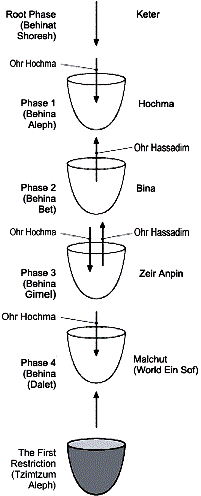 By feeling its Upper Nine attributes (the attributes of the Creator that Malchut feels within), which comprise the way the Creator relates to Malchut, it begins to understand how it can give back to the Creator. It decides that if it would receive the Light and enjoy it because the Creator enjoys its delight, then that would make its reception tantamount to bestowal.
The reception of pleasure by the receiver in order to please the giver turns an act of reception into one of bestowal. If Malchut receives the entire Light (pleasure) that the Creator had prepared for it, then it will give the Creator just as much as He is giving Malchut.
For example: there is a guest and a host. The host treats his guest with delicacies the guest would love to have. (The desire is in perfect fit with the Light in both quantity and quality, because the pleasure-light created the vessel-desire this way). But although the guest is very hungry, the presence of the host makes him feel ashamed, and that stops him from eating. The shame stems from the fact that he feels himself as a receiver, and the host as a giver. The shame is so strong that he can no longer eat.
But the constant pleas of the host, who have prepared it all for him, finally persuade him that the host will enjoy it if he eats. Then the guest thinks that if now, after having rejected the pleasure several times, he will agree to eat, it will be considered a favor to the host. In this way, he will become the giver, and the host, the receiver.
The hunger and the desire to receive delight and pleasure are referred to in Kabbalah as a "vessel." The pleasure emanating from the Creator is called Direct Light, and the power to reject it is called a "screen." The Light that is rejected from the screen is then referred to as Returning Light. With the power of the screen; i.e., the force to reject enjoying for self and taking pleasure only for the Creator, the vessel can face its own will to receive. One might understand that the vessel rejects the Light, but it would be more accurate to say that the vessel rejects the use of the desire in order to please itself.
The Screen Rejecting the Light
The vessel cannot return Light to the Creator, but only change the intention. The intention to delight the Creator, what we call "the Returning Light," is only synonym for pleasure. Direct light is tantamount to the pleasure that the Creator wants to render the creature. Returning Light is the pleasure that the creature wants to give the Creator.
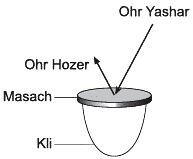 Once the vessel (guest) is certain that he will not receive itself, it examines the magnitude the magnitude of the Light it returns (how much pleasure he wants to give the Creator). It then decides to receive from the abundance before it; i.e., the Direct Light, which holds the delicacies and pleasures the Host has prepared for the guest. However, it will take only as much as the guest can eat in order to please (delight) the Creator; i.e., the Host.
Kabbalists are people who feel the Light that comes from the Creator and every action He performs, but when they write about spirituality, they convey their feelings in technical terms. Therefore, if the reader has the screen and the strength the books describe, he or she can translate the words into feelings by repeating the same actions described in their books.