Hevruta - Following Lesson 21 - The structure of the upper worlds
The structure of the upper worlds Hevruta - Following Lesson 21 We will read again some part of the exerpts from last Sunday (not all because we probably will not have time) and then we have an explanation from …
The structure of the upper worlds
Hevruta - Following Lesson 21
We will read again some part of the exerpts from last Sunday (not all because we probably will not have time) and then we have an explanation from Rav Michael Laitman and some room for discussions and questions
From Baal HaSulam - The Preface to the Wisdom of Kabbalah
...The thought of creation was to delight the created beings in accord with His abundant generosity. For this reason, a great desire and craving to receive His abundance was imprinted in the souls.
This is so because the will to receive is the vessel for the measure of pleasure in the abundance, since the measure and strength of the will to receive the abundance precisely corresponds to the measure of pleasure and delight in the abundance. And they are so connected that they are indivisible, except in what they relate to: The pleasure is related to the abundance, and the great desire to receive the abundance is related to the receiving created being.
...
And know that these are the light and vessel that we discern in the upper worlds. They necessarily come tied together and cascade together degree by degree.
...
The reason why the will to receive must cascade by the four above-mentioned discernments in ABYA [Atzilut, Beria, Yetzira, Assiya] is that there is a great rule concerning the vessels: The expansion of the light and its departure make the vessel fit for its task. This means that as long as the vessel has not been separated from its light, it is included in the light and is annulled within it like a candle before a torch.
...
Hence, the four phases in the name HaVaYaH, called Hochma, Bina, Tifferet, Malchut, are required. Phase one, called Hochma, is indeed the whole of the emanated being, light and vessel. In it is the great will to receive with all the light included in it, called “light of Hochma” or “light of Haya,” as it is all the light of Hayim [life] in the emanated being, dressed in its vessel. However, this phase one is regarded as all light, and the vessel in it is barely noticeable as it is mingled with the light and annulled in it as a candle in a torch.
Following it comes phase two, since at its end, the vessel of Hochma intensifies in equivalence of form with the upper light in it. This means that a desire to bestow upon the Emanator awakens in it, according to the nature of the light within it, which is entirely to bestow.
Then, using this desire that has awakened in it, a new light extends to it from the Emanator, called “light of Hassadim.” As a result, it becomes almost entirely separated from the light of Hochma that the Emanator imprinted in it, since the light of Hochma can only be received in its own vessel—a desire to receive that has grown to its fullest measure.
Thus, the light and vessel in phase two are utterly different from those in phase one, since the vessel in it is the desire to bestow. The light within it is considered light of Hassadim, a light that stems from the adhesion of the emanated being in the Emanator, as the desire to bestow causes it equivalence of form with the Emanator, and in spirituality, equivalence of form is adhesion.
Next follows phase three, since once the light in the emanated being has diminished into light of Hassadim without any Hochma, and it is known that light of Hochma is the essence of the emanated being, hence, at the end of phase two, it awakened and drew into it a measure of light of Hochma to shine within its light of Hassadim. This awakening re-extended a certain measure of the will to receive, which forms a new vessel called phase three, or Tifferet. And the light in it is called “light of Hassadim in illumination of Hochma,” since the majority of this light is light of Hassadim, and its lesser part is light of Hochma.
Following it came phase four, since the vessel of phase three, too, awakened at its end to draw the complete light of Hochma, as it was in phase one. Thus, this awakening is considered “craving” in the measure of the will to receive in phase one and exceeds it since now it has already been separated from that light, as the light of Hochma is no longer clothed in it but craves it. Thus, the form of the will to receive has been fully determined, since the vessel is determined following the expansion of the light and its departure from there. Later, when it returns, it will receive the light once more. It turns out that the vessel precedes the light, and this is why this phase four is considered the completion of the vessel, and it is called Malchut [Kingdom].
(From a talk with Rav Michael Laitman)
The Thought of Creation and His Essence
Kabbalists attained spirituality and wrote about it in their books. They perceived that the root of the entire reality is a Upper Force, which they named “His Essence”, because they could not attain the Force itself. However, they did perceive that there is a thought, an aim, to create creatures in order to bring them pleasure, which comes from His Essence. They named that thought and aim “The Thought of Creation”, or “Upper Light.” It turns out that from the creature's perspective, the Light is the Creator, because it cannot attain His Essence. Hence the Creator-creature contact is maintained through the Upper Light.
In short, there is a Light that stems from His Essence. The Light wants to create a creature and delight it by filling it with pleasure. That is, the purpose of the Light is to create a creature that would feel the Light as pleasure.
(From a talk with Rav Michael Laitman)
Lack and Fulfillment: Kli and Light
The Kabbalists therefore called the creature “vessel” and the Light “filling.” The Light that stems from His Essence in order to create the creature is called Behinat Shoresh (Root Phase), because it is the root of the entire reality. That Light then creates a desire to take pleasure in the Light. The desire for pleasure is also called “Will to Receive” (Light).
The intensity of the pleasure depends only on the intensity of the desire to receive it, just as in our world one may have an empty stomach, but no desire to eat. Hence, the desire is the vessel for the filling, and without it there is no pleasure. There is no coercion in spirituality and the filling is only equal to the desire.
The Light that stems from His Essence creates a vessel and fills it. The pleasure that the creature feels when it receives the Light is called Ohr Hochma (Light of Wisdom). The desire created by the Light that fills it is called B'hina Aleph (First Phase). It is called by that name because it is the first B'hina (realisation/discernment) of the future vessel. But that desire is not yet an independent one, as it is created directly by the Light.
The actual creature is the one whose desire to enjoy the Creator's full Light for its own delight. This desire and the decision to enjoy it for self arise from within. Such desire needs to be imprinted in it by the Creator.
In order to receive Light, the creature must know how intense the pleasure from the Light is before it receives it. Then, it must be filled with Light, and then feel what it is like to be without the Light. Only then is the real desire for the Light created.
In much the same it happens in our own lives, when a person is given a new fruit to taste, there is no preliminary desire for it. But if one tastes it and feels the pleasure in it, and the fruit is then taken away, the person begins to crave it and wishes to bring back the pleasure. It is precisely that desire, the new desire born in man, that is what man feels as an independent will.
(From a talk with Rav Michael Laitman)
4 Steps to build a complete desire
Hence, it is impossible to build the vessel all at once. In order for the desire to know what to delight in, and recognize its own desire to enjoy, the desire must go through the entire chain of events. That condition is presented as a law in Kabbalah: “The expansion of the Light and its departure, make the vessel worthy of its task,” which is to receive Light and enjoy it. The phases of the evolution of this desire are called Behinot (phases/distinctions/observations) because they are phases in the building of discernments/observations in the will to receive.
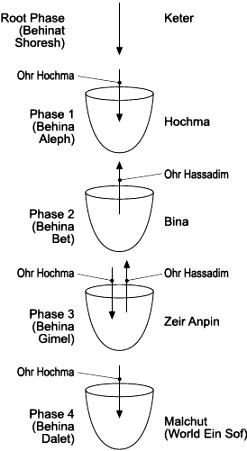
Thus, along with the pleasure, the Light renders the vessel with the attribute of bestowal. And the vessel suddenly discovers while enjoying the Light that it wants to give, just like the nature of the Light that fills it. This is because the Creator purposely rendered the Light with the ability to convey its own attributes along with the desire to bestow. Once the Light fills up the vessel in the first phase, the vessel feels that it want to be like the Creator. And because this is an entirely new desire, it is an entirely new observation, named Behina Bet (Second Phase).
Behina Bet is a desire to give. The pleasure it feels at resembling the Creator is called "the Light of Mercy." Thus we see that Behina Aleph is opposite to Behina Bet because the desire of Behina Aleph is the will to receive, whereas that of Behina Bet is the will to bestow. The Light in Behina Aleph is a "Light of Wisdom," and that of Behina Bet is a "Light of Mercy."
When the will to receive in Behina Aleph begins to enjoy the Light that fills it, it immediately feels that the Light is the giver of the pleasure and that the will to receiver of the pleasure, and thus begins to want to be like the Light itself. Rather than receive the pleasure, there is a desire to give it, like the Light.
Hence, the original will to receive leaves, and the vessel remains empty of the Light of Wisdom, because pleasure can be felt only when there is a desire for it.
The will to receive cannot remain without the Light of Wisdom, because the Light of Wisdom is its livelihood. Therefore, this will to receive must take in a little bit of the Light of Wisdom. Thus, this new desire, called Behina Gimel (Third Phase) consists of two desires:
-
A desire to resemble the light.
-
A desire to receive a small amount of Light of Wisdom.
The vessel now feels two Lights: the Light of Mercy in the will to bestow, and the Light of Wisdom in the will to receive.
When Behina Gimel receives Light, it finds that between the Light of Wisdom and the Light of Life, the former is more consistent with its nature. It then decides to receive this Light fully. Thus an independent desire to receive the Light of Wisdom, and the very desire with which the Creator wants to fill the creature is now created.
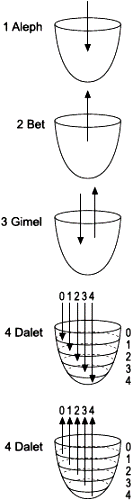
We see that the Light that emanates from His essence creates a vessel in four steps. That is why that final desire, named Behina Dalet (Fourth Phase), is in fact the only creature. All the phases that preceded it were only phases in its evolution. In fact, the entire Creation is comprised of that fourth phase. Everything that exists, except for the Creator, is that Behina Dalet. This Behina Dalet is named Malchut (Kingship), because the will to receive governs it.
Four Phases
The fourth phase is the only creature. It is divided into outer parts and inner parts. The outer consists of Sefirot, Partzufim, worlds, and our world, and the still, vegetative and animate. The inner part consists of the human souls. The difference between those parts is only in the magnitude of their will to receive.
When the fourth phase is entirely filled with Light of Wisdom, it is called Olam Ein Sof (World Without End), because its desire doesn’t limit the reception of the Light. The fourth phase receives through the four prior phases: Root, First, Second, and Third. It turns out that the fourth phase is divided into five parts (including its own phase) of will to receive.
Summary
Light comes from the Creator, or the Root Phase. The Light then creates a creature, the fourth phase, in four phases. The essence of the creature is the desire to receive pleasure. The pleasure is the sensation of the Light within the desire. The fourth phase is then divided into four inner parts, which receive Light from the four preliminary phases. The fourth phase, filled with Light of Wisdom, is called the "World of Ein Sof" (no end). The parts of the fourth phase are called "souls" and "worlds." The worlds contain Partzufim, Sefirot and everything that is not souls.
From Baal HaSulam:
Now you can understand the real difference between spirituality and corporeality: Anything that contains a complete desire to receive, in all its aspects, which is phase four, is considered “corporeal.” This is what exists in all the elements of reality before us in this world. Conversely, anything above this great measure of desire to receive is considered “spirituality.” These are the worlds ABYA, which are above this world, they and the whole reality within them.
Now you can see that the whole issue of ascents and descents described in the upper worlds does not relate to an imaginary place, but only to the four phases in the will to receive. The farther it is from phase four, the higher it is considered to be. And conversely, the closer it is to phase four, the lower it is considered to be.
Points for Conversation / Workshop
- What are your impressions from these texts compared to others like Shamati or the Freedom from Baal HaSulam?
- Any questions on the text?