Hevruta - Following Lesson 23- The structure of the upper worlds
The structure of the upper worlds Hevruta - Following Lesson 23 Let's review the main concept we have seen so far Light Kli 4 Phases of Direct Light First Restriction / TsimTsum Alef Masach (Screen) Orh Yashar Orh Hozer Rosh …
The structure of the upper worlds
Hevruta - Following Lesson 23
Let's review the main concept we have seen so far
Light
Kli
4 Phases of Direct Light
First Restriction / TsimTsum Alef
Masach (Screen)
Orh Yashar
Orh Hozer
Rosh
Toch
Sof
The following is taken from a lesson of Rav Dr. Michael Laitman
(Link in English /Russian/Hebrew/Spanish)
When we approach to explain any state from the states of development, it is good to clarify all the stages of development, from the beginning of reality until the state we wish to explain. Therefore, let us return again to the four phases of Orh Yashar, and clarify the ways of the creation of the first Kli by the upper force called Light.
The upper Light spreads and builds opposite to it a Kli called desire. The Light spreads within the desire and fills it. When the Light fills the Kli, the Kli feels pleasure. At the end of the feeling of pleasure, and as a result of it, the Kli also discerns the source of the pleasure. It feels that the pleasure comes from someone whose will is to bestow, to do good to it.
The feeling that the pleasure comes from the bestower arouses in the Kli a desire to bestow. Naturally, the Kli is drawn to act similarly to its own source. Thus, just as the will of the good is to bestow, so too the Kli wants to give, to bestow. The first phase becomes the second phase. The first phase wants to receive and the second to bestow, each one opposite from the other.
In addition to the pleasure, there is also in the Light the feeling of the bestower—who is the bestower and what is his nature. From here comes the desire of the second phase to bestow. The Kli in phase Aleph is called Hochma, and the Kli in phase Bet is Bina.
The next stage in development is a Kli that wants to carry out the will of Bina to give. The Kli, whose desire is to receive, can give only if it receives in order to bestow, in order to give. The third stage in development, in which the Kli receives in order to bestow, is called "Zeir Anpin."
When the Kli receives in order to bestow, its effort is equal to the effort of the Creator to give. In phase Aleph the Kli received, in phase Bet it wanted to resemble the bestowing force, and in phase Gimel to resemble the action. When the Kli performs the act of giving like the Creator, it is revealed to it how high is the exaltedness of the Creator, how complete the Creator is, and a desire develops in it for the perfection of the Creator.
As a result of the act of giving in phase Gimel, there develops in the Kli a desire to receive everything, to receive the Light as pleasure and as the giver of pleasure. The Kli wants to enjoy receiving the pleasure and from the status of the giver of pleasure. The Kli wants for itself all that is in the Creator. If in phases Bet and Gimel the Kli wanted to resemble the Creator, to resemble the act of the Creator, then in the fourth phase it wants to enjoy the status of the Creator, as a receiver.
In the fourth phase, the desire to receive rules in all its might, and from here comes its name—"Malchut." The fourth phase is also the last stage in the development of the Kli, therefore we call it by the name "created being."
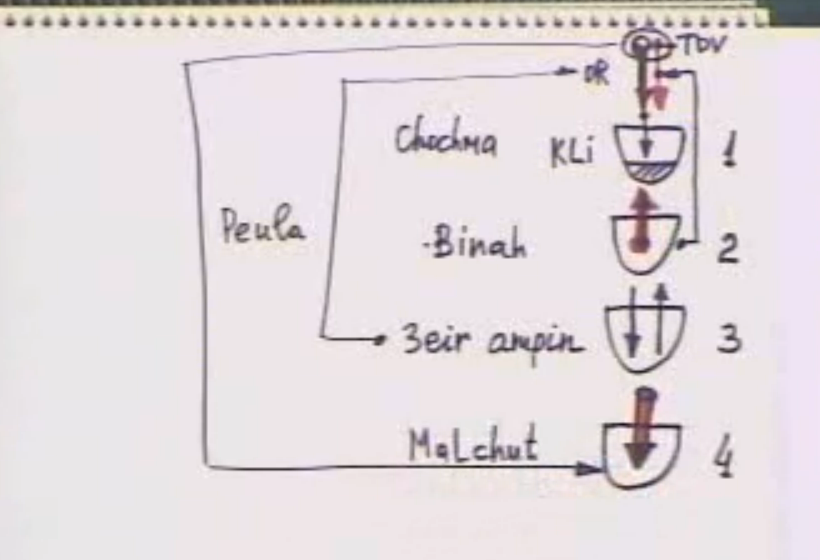
As a result of receiving all the Light in Behina Dalet, the Kli begins to feel itself as a receiver. The state of the Kli in Behina Dalet, filled with Light, is called “Ein Sof.” When the Kli feels itself as a receiver and the Light as the giver, it cannot bear the contrast and the gap between itself and the Light. Therefore, it expels all the Light from itself in an action called Tzimtzum Aleph. The difference that the Kli feels between itself and the Light is called “shame.” The shame causes the Kli to contract, and as a result of the contraction, the Kli remains empty of Light. The Light is before the Kli, and the Kli is empty, free, there is nothing inside it.
The Light departed from the Kli. The state of Behina Dalet filled with Light is called “Olam Ein Sof,” and the state of the empty Kli after Tzimtzum Aleph is called Olam HaTzimtzum. The state after Tzimtzum Aleph is unique. The Kli, that is, the created being, remains alone. After Tzimtzum Aleph, the Kli is not connected with the Light and is not under the control of the Light. It is free. After Tzimtzum Aleph, the Creator and the created being are separated from each other.
From here we learn that the purpose of all the actions done in the Kli is to allow the Kli to detach from the Light and determine its own desire by itself. In the restricted Kli are all the impressions from previous states. Now, being empty, it has the possibility to act according to the information that remained in it from past states, and to decide on its desire.
Thus, the Kli examines its previous states. It finds that its state in Olam Ein Sof is similar to Behina Aleph, filled with Light. It also discerns the closeness between its state in Behina Bet, when it rejected the reception of the Light, and its state after feeling the shame and the departure of the Light from within it. The development of the Kli in Behinot Gimel and Dalet did not bring it to a good feeling; it nevertheless felt shame after them. So, what should it do, what is the best state that can be?
The Kli remains empty. Empty of pleasures, empty of the feeling of the Creator, in the most severe state. It cannot receive; if it receives, it will feel shame. To such an extent is the shame of the Kli great and terrible that it is willing to give up all pleasures and fulfillments, as long as it does not feel the shame.
In its full state, the Kli feels shame; in its empty state, it lacks vitality. The Kli must find its complete and eternal state, a state that does not need to be changed. If it attains its complete state, it will merit eternity. Eternity and completeness are one and the same. For if something is lacking in the complete, if it is necessary to add something to it, then it is not complete at all. The complete never changes. So, how is it possible to have a complete and eternal state, a state that will not obligate the created being, a state in which the created being will be satisfied and complete? For this is what the Kli wants; after all, in the end, the desire of the Kli is to receive.
From these calculations it becomes clear that the only complete state is to be like the Creator. The Kli must resemble the Creator. The Kli must take the Creator as an example and strive to resemble Him, to reach the same level as the Creator.
The Kli seeks to know how to resemble the Creator and finds a way. The Creator gives, the Creator loves the created being and gives him pleasure. If the created being could give to the Creator just as the Creator gives to him, the created being would resemble the Creator. But how is it possible for the created being to give to the Creator, since the created being has nothing to give?! The solution is simple: if the Creator loves the created being, the created being will use the Creator’s love to give back to the Creator.
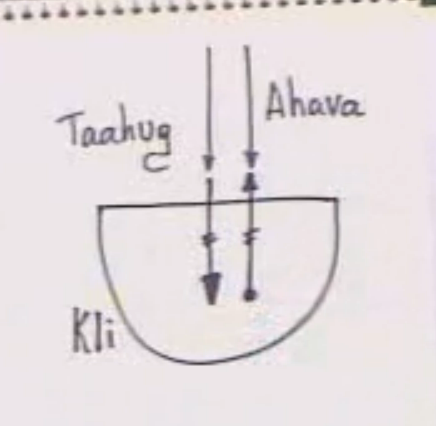
From the Creator, pleasure and a feeling of love come to the created being. The created being decides to use both. He receives the pleasure, but not because of his desire to enjoy. In receiving the pleasure, the created being expresses his love for the Creator, similar to the Creator’s love for him. The created being receives only in order to express his love for the Creator, only in order to delight the Creator. If the created being delights the Creator, he and the Creator become equal to each other. The receiving in order to delight the Creator is performed by the created being with the help of “intention,” by means of the thought during the reception of the pleasure. The work of the Kli with the intention we call “Masach.”
Let us describe the work of the Kli with the Masach. Light comes from the Creator to the created being—pleasure. The created being decides not to receive the Light for himself and rejects the Light backward. After rejecting the Light, the created being calculates, according to his intention, how much he is able to receive in order to delight the Creator and not for his own enjoyment. According to the correct calculation, he receives the pleasure within himself. He receives it to a certain extent, according to his ability to maintain himself in the intention.
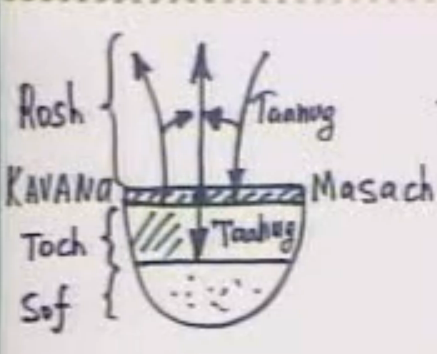
The empty Kli after the first Tzimtzum now divides into two: a place where it is possible to receive pleasure and a place where it is impossible to receive pleasure. The place in the Kli where the calculation is made is called “Rosh.” The place where the pleasure is received is called Toch, and the place that remains empty of Light due to the lack of Masach is called “Sof.” The one general Kli is therefore divided into three parts: Rosh, Toch, Sof. About this Kli, the wisdom of Kabbalah teaches us; this Kli is called the created being.
The created being must resemble the Creator. Resemblance to the Creator is possible if the Masach, which separates between the Rosh and the Toch, decides how much pleasure to receive within the Kli. The Masach defines the division of the Kli into Toch and Sof. If the Masach is large, the Toch part is large and the Sof is small. The Toch and Sof together are called the body. The Kli, similar to the physiological body, is divided into body and Rosh. Later on, we will learn about its division into hands, legs, and other organs of the body. The division of the spiritual Kli gradually defines the formation of the physiological body in our world.
The Kli is surrounded by its external parts, which are called “worlds,” and the Kli itself is divided into many parts, which are the people in our world. The Kli is divided into internality and externality that we feel in our world. All of reality in our world is a consequence of the general Kli that was created after the world of Ein Sof. From Tzimtzum Aleph and onward, the study focuses on the ways the Kli descends until our world.
As mentioned, in the four Behinot of Orh Yashar, the Kli is created from the upper force. The Kli restricts itself in Tzimtzum Aleph, places a Masach upon itself, and by means of the Masach builds itself and the worlds. The first world is called “Adam Kadmon.” After it, the worlds “Atzilut,” “Beria,” “Yetzira,” “Assiya,” and “this world” are created. In our days, after thousands of years of development in this world, a person begins to return to Ein Sof, until the completion of his development with attaining the degree of the Creator.
The entire study, from the beginning of reality to its end, is called the wisdom of Kabbalah. All the wisdoms of the world, all information that is related to this world, is included in this wisdom. The subjects of research of the wisdom of Kabbalah are the root of all reality, and all the details of reality in all the worlds up to this world. About the general plan that humanity is obligated to carry out, my teacher, Rav Baruch Ashlag, writes in the article “To What Degree Must a Person Attain?”
All of humanity exists as one Kli in the world of Ein Sof; its division into eight billion people or nine does not change the fact that all are connected together as one Kli. Every person must reincarnate down to the lowest place, to our world, and from there rise back to the general Kli. In any case, it is impossible to descend to a worse state than our state in this world.
One who has not completed his task during his life in this world will reincarnate again and be born in this world as one of mankind. He will have to begin and continue ascending to his spiritual root. As long as a person has not completed his role, he will reincarnate into this world again and again.
If so, asks Rabash, to what spiritual degree must a person attain so that he will not reincarnate again? And he writes there: “Behold, in Shaar HaGilgulim of the Ari, it is written there that every person must reincarnate until he is completed in all the NRNHY, that is, until he receives all the Light intended for him.”
The Light that fills the general Kli of all the souls is called NRNHY. NRNHY are the five Lights Nefesh, Ruach, Neshamah, Chaya, Yechida, which necessarily fill the complete Kli. From this, we can understand the words of the Ari, that a person who attained spiritual attainment during his life and did not complete his path must continue to reincarnate. He will have to continue his spiritual path in his life in this world.
Each one of us has lived in the past in this world in previous incarnations, and has gone through certain processes. The connection that each one of us has made with the wisdom of Kabbalah indicates the possibility that even in previous lives we were connected to the wisdom. Therefore, even today we continue to advance in the same direction.
If suddenly, during his life, a desire awakens in a person to study the wisdom of Kabbalah, it means that part of the way he has already passed in his previous lives. Now, in his current incarnation, he continues onward. Thus, as long as a person has not completed the filling of the general Kli with Light, he will have to continue and reincarnate into life in this world.
When we come to investigate the nature of the completion of the filling of the general Kli with the Light of NRNHY, we must know that the entire path, from its beginning to its end, is divided into a descent from above to below and an ascent from below to above. In the descent from above to below, up to this world, the worlds are created and the souls are built. In this world, the person lives in his body and in his soul, and from this world he must begin his ascent. Within the framework of the wisdom of Kabbalah, we learn about the creation of all the worlds, about the descent of the souls down to this world, and about the way in which we can and must ascend from this world up to Ein Sof.
First, we will learn about the creation of the world of Adam Kadmon, we will investigate the stages of its formation from the state that preceded it.
As is known, in the four phases of Orh Yashar the Kli was created, and received all the Light in the world of Ein Sof. After receiving the Light in the world of Ein Sof, the Kli made a Tzimtzum and remained empty. The Kli decided to work only with the Masach, with a calculation of how much Light can be received inside the Kli and how much cannot. After these decisions, the world of Adam Kadmon was born.
Each one of the states of the Kli leaves behind “Reshimot.” The Reshimot are information about each stage of the development of the Kli. For example, phase Bet will contain within it a Reshimo from phase Aleph and is built upon it. Phase Gimel contains within it Reshimot from phases Bet and Aleph. If we describe the order of the Reshimot within phase Gimel, the Reshimo from phase Aleph is the innermost, the Reshimo from phase Bet is external to the Reshimo from phase Aleph, and phase Gimel itself is the most external of all.
The Kli that works with the Masach contains within it all the previous states, and in relation to them makes its decisions. The Upper Light spreads and is drawn to the Kli and wants to fill it. The Kli rejects the Light, for if it receives, it will feel shame. The Kli decides what measure of Light it is able to receive without feeling shame, so that it will equalize itself with the Light precisely. In the reception of the Light by the Masach, the Kli becomes a bestower, a giver.
We have explained the manner of operation of the Masach with the example of the host and the guest. A person is a guest at his friend’s house. The friend invites him to enjoy the food he has prepared for him, and he declines the invitation. The guest feels himself as the receiver and the host as the giver; the feeling of shame arises in him. In relation to the host, he feels the giver as superior. The feeling of the gap between his lower degree and the higher degree of the giver arouses in him a feeling of shame.
How can the guest receive, enjoy, and not be ashamed? The guest declines the invitation to enjoy the food. The host urges him to eat nonetheless, explaining to his friend that he has prepared the food especially for him. The guest continues to refuse the repeated urgings of the host, until the point where the pressure of the host and the refusal of the guest become equal. The host does not receive, and so does the guest; the host does not give, and so does the guest. The host and the guest become equal to each other, and the refreshments remain on the table between them.
Now, the guest has the possibility to change his form from receiver to giver. The food, the host prepared especially for the guest as an expression of love. The host wants the guest to enjoy. The guest will sadden the host if he refuses his invitation.
Therefore, the guest decides to receive; his entire intention is to bring pleasure to the host. If he does so, he will not feel himself as inferior and the host as superior; he will bestow to the host—the Kli will bestow to the Creator.
The created being decides to bestow to the Creator by receiving pleasure from the Creator. In this way, the Creator and the created being become equal to each other. The created being receives from the Creator in order to bring Him pleasure, and as a result, they become equal. The Creator gives pleasure to the created being, the created being receives the pleasure from the Creator, and by receiving the pleasure, causes pleasure to the Creator.
All that a person lacks is the intention to receive the pleasure for the sake of the Creator. The intention is formed in the Kli, in the Rosh of the degree. In relation to his desire, the Kli examines how much he is equal to the Creator, and decides the measure in which he will activate his desire. The boundary that marks the measure of the Kli’s ability to activate his desire is called “Tabur.” The place where the Kli can fill its desires with pleasure is called “Toch,” the end of the Toch is at the Tabur.
The place that cannot be filled with pleasure, from the Tabur and below, is called Sof (end). The Sof part of the Kli rejects the pleasure and remains empty. The pleasure that the Creator bestows to the Kli in the desires of the Sof part is so great that it is unable to receive it in order to bestow.
Let us return to the parable of the host and the guest. Let us suppose that the host honors the guest with meat, fish, dessert, and drink. The guest considers which of the foods he can receive and enjoy only for the sake of the host, and not for his own sake. He takes into account his desire, the pleasure, and his recognition of the greatness of the host, and in relation to all these decides what he is able to receive. The drink, for example, he can allow himself. Also the dessert and some of the fish he can eat; the pleasure in them is not too great. The guest can receive them and enjoy them for the host.
The meat he is unable to receive. If he eats the meat, he will not think of the host; if he eats the meat, he will be entirely focused on the thought of the pleasure.
The Kli limits itself. Part of the pleasure it is able to receive within itself and part not. The calculation is made according to the data acquired in previous work—in the four phases of Orh Yashar, in the world of Ein Sof, and in the first restriction (Tzimtzum Aleph)—according to his experience from previous states.
It is good if we place ourselves as guests in the parable of the host and the guest, and think about how to receive in order to bestow to the Creator. Such a thought develops Kelim in a person. In doing so, a person will come to know how precise is the calculation whether to enjoy for oneself or to enjoy for the host. If a person is entirely occupied with the correct calculation to enjoy for the host, he ceases to feel the tastes in the food. To such an extent is a person immersed in pleasure for himself.
For example, if a person drinks a cup of coffee with the intention to give pleasure to the host—only for the sake of the host and not for himself—he will not feel taste in the coffee. After all, his intention is to transfer the pleasure to the host, but he does not feel the host; therefore, the taste disappears. In the effort to imagine himself as a guest, a necessity for the revelation of the host is formed in a person. For if the guest does not feel the host, if he does not see him, he will not be able to perform the act of giving.
In such a state, a person has no choice but to demand the revelation of the host. He demands His revelation in order to bestow to Him; otherwise, he will not receive anything from Him. When the Creator sees that the created being stands firmly in his desire to receive for His sake, for the sake of the Creator, He begins to reveal Himself. When the Creator recognizes the refusal of the created being to receive by any calculation other than to give pleasure to the Creator, the Creator begins to show Himself. The Creator reveals Himself and helps the created being to make a calculation of bestowal.
When the Upper Force is revealed to the created being, the Creator and the created being begin to connect to each other. The revelation of the Upper Force is possible only on the condition that the created being stands his ground and refuses to receive not for the benefit of the host. The created being wants to receive only in order to give; in this, he compels the Creator to reveal Himself.
Exercises such as these in “practical Kabbalah,” attempts to receive on the condition that the reception will be connected to the Creator, are good exercises. It is worthwhile for a person to check himself to see if he is able to withstand this. Through the study of the wisdom of Kabbalah, and through such experiences, a person can bring himself to a state where he does not receive anything for himself, only for the benefit of the Creator—if the Creator does not reveal Himself, he does not receive anything. Then the Creator must reveal Himself.
Check yourselves. If you set before the Owner of the house the condition—that you refuse to receive except only for Him—the Owner of the house will have to be in contact with you. Under such conditions, a person is rewarded with the revelation of the Creator. According to the measure of a person’s ability to demand the revelation of the Creator with the intention to bestow, the Creator is revealed. Thus, the Creator helps a person to rise to higher degrees of bestowal. Write down this exercise as “homework.” The difficulties that will arise as a result will help in the advancement.
Let us return to the stages of the development of the Kli. Light is drawn and spreads to the Kli. The Kli rejected the Light. The Kli made a calculation in the “Rosh” and received a portion of the Light within it. For the sake of the example, let us assume that the Kli received twenty percent of the Light, and eighty percent remained empty. The portion of the Light that the Kli received is called “Inner Light.” The place where the calculation was made is called “Pe,” and the boundary for the reception of the Light is called Tabur. The place where the Kli ends is called “Sium.”