"Hevruta" - following Lesson 14. The Book of Zohar
The Book of Zohar
It is a unique book that all the kabbalists over the years have talked about its importance, before we start, let's read what some of the greatest of kabbalists before us have wrote about it.
The Creator has no contentment in his world except when we engage in this Wisdom. Moreover, man was not created except to study the Wisdom of Kabbalah.
Chaim Vital, Introduction to Shaar HaHakdamot
What was decreed Above that they should not be engaged in the wisdom of the truth openly was for a limited time, until the completion of the year 1490. And from then on, it would be called the Last Generation, tand he decree was rescinded, and permission was given to engage in the Book of Zohar. And from the year 1540 it has been a choice to engage in it publicly, old and young. And ... it is inappropriate to be negligent.
(Rabbi Avraham ben Mordechai Azulai, introduction to the book, “Ohr HaChama”)
This point in time requires accelerated acquisition of the inner Torah. The Book of Zohar breaks new paths, makes a highway in the desert, the Zohar and all it harvests are ready to open the doors of redemption.
The Rav Raiah Kook, Orot
Had my people listened to me in this generation, they would have studied the Zohar and the Tikunim with a nine year old child, to reflect on them, and the fear of its sin would have preceded its wisdom and prevail.
Rabbi Isaac Sefarin, Notzer Chesed, Chapter 4, Mishna 20
When engaged in this book, the power of the souls and the power of the righteous are awakened with the power of Moses…. For when they engage in It, they renew the Light that was renewed at the time of its composition, and the Divine shines and illuminates with that Light as in the beginning of Its renewal then. And all who engage in it return and awaken that same benefit and that previous Light which Rabbi Shimon bar Yochai and his friends revealed at the time of its writing.
(Rabbi Moshe Cordovero, the Ramak, “Ohr Yakar”, Gate 1, section 5)
Listen to me my brothers and friends, the friends who yearn and seek the true truth of the service of the heart, to view the pleasantness of the Creator and to visit his Palace, my soul will bow down and adhere to the Book of Zohar, as was known from the mouths of our predecessors the remedy of engaging in the holy book.
(Rabbi Tzvi Hirschof Zidichov)
Now let's talk about the book itself.
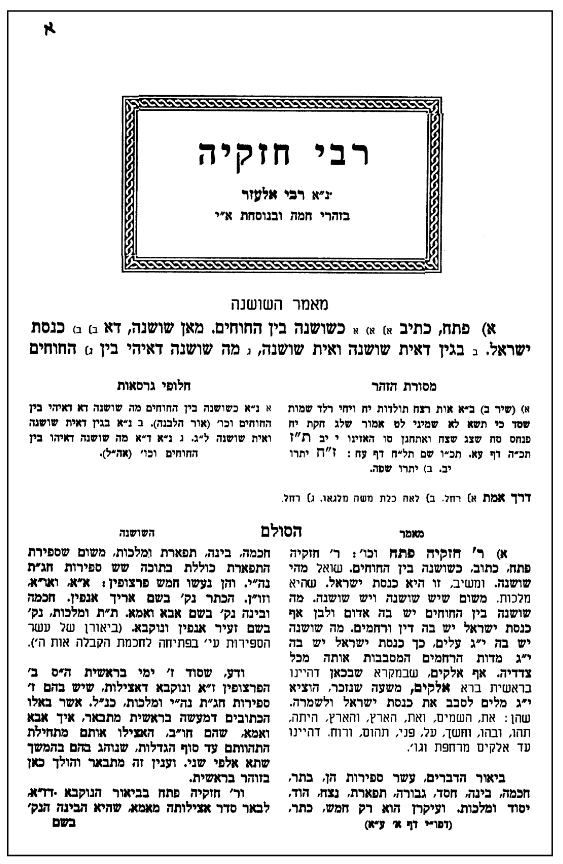
It was written by Rabbi Shimon Bar Yochai in 2nd century - but was then hidden and we recovered it in Spain , through Rabbi Moshe de Leon.
The book as we know it contain the following parts:
1. Hakdamat Sefer HaZohar (The Introduction of the Book of Zohar) —containing
several articles that fully reveal the inner meaning of the Torah.
2. Sefer HaZohar (The Book of Zohar )—divided into parts and chapters that
correspond to the weekly portions of the Torah:
- The Book of Beresheet (Genesis): Beresheet, Noach, Lech Lecha, Vayera, Chaiey
Sarah, Toldot, Vayetze, Vayishlach, Vayeshev, Miketz, Vayigash, Vayichi.
- The Book of Shemot (Exodus): Shemot, Vayera, Bo, Beshalach, Yitro, Mishpatim,
Terumah (Safra de Tzniuta), Tetzaveh, Ki Tissa, Veyikahel, Pekudey.
- The Book of Vayikra (Leviticus): Vayikra, Tzav, Shmini, Tazria, Metzura,
Acharey, Kedushim, Emor, BaHar, Vechukotay.
- The Book of Bamidbar (Numbers): Bamidbar, Naso (Idra Raba), Baalotcha,
Shlach Lecha, Korach, Chukat, Balak, Pinchas, Matot.
-The Book of Devarim (Deuteronomy): VeEtchanen, Ekev, Shoftim, Titze,
Vayelech, Haazinu (Idra Zuta).
3. Zohar Hadash (The New Zohar): additions to the weekly chapters
4. Additional books in The Book of Zohar that are not a direct commentary
on the Torah:
- Idra Raba
- Idra Zuta,
- Safra de Tzniuta
- Raza de Razin,
- Tosefta,
- Raya Mi’emna,
- and more: Ashmatot, Sitrey Torah, Sitrey Otiot, and Tikuney Zohar.
5. Midrash HaNe’elam (The Commentary on the Writings): Song of Songs, Ruth,
Eicha (Lamentations)—and on the Torah (Pentateuch).
Now let's read some with the explanation of Rav Dr. Michael Laitman
The rose
Rabbi Hizkiyah opened (began): “It is said, as a rose among thorns” (Shir
HaShirim, 2:2). He asks, “What does a rose represent?” He answers, “It is the
Assembly of Israel, meaning Malchut. For there is a rose, and there is a rose.
Just as a rose among thorns is tinged with red and white, so does the Assembly
of Israel (Malchut) consist of judgment and mercy. Just as a rose has thirteen
petals, so the Assembly of Israel consists of thirteen properties of mercy,
surrounding it on all sides. After all, Elokim (the name of the Creator that
alludes to His attitude towards the lower ones by the force of judgment), as
it is said, ‘In the beginning, Elokim created’ (the first sentence in the Torah),
In the beginning (initially) when He thought it, He created thirteen words to
surround the Assembly of Israel and to protect it, and here they are: THE,
HEAVEN, AND-THE, EARTH, AND-THE EARTH, WAS, EMPTY, AND-
CHAOTIC, AND-THE DARKNESS, OVER, THE FACE, OF THE ABYSS,
AND-THE SPIRIT, up to the word Elokim” (In Hebrew, “and” is written in
conjunction with the word following it. Hence, it is considered as one word).
Explanation of Rav Laitman:
As its object of study, Kabbalah takes the only creation, the only thing that
exists besides the Creator—man’s self, or “I,” and researches it. This science breaks
down the self into parts, explains the structure and properties of each part, and
the purpose of its creation. Kabbalah explains how every part of man’s self, called
“the soul,” can be changed so that one would reach the goal of creation, the state
desired by both the Creator and man himself, provided he realizes it.
There is not a science in the world that can describe, either graphically or
analytically, through use of formulas, our sensations and desires, and how diverse
and multifaceted they are. That is how fickle, unpredictable, and absolutely
distinct they are in everyone. This is because our desires surface in our mind
and sensations in a gradual order, in a certain sequence, so we may acknowledge
and correct them
In all, there are ten degrees, called “ten Sefirot”: Keter, Hochma, Bina, Hesed,
Gevura, Tifferet, Netzah, Hod, Yesod, and Malchut. Like ten screens or curtains,
these ten Sefirot conceal the Creator’s Light from us or the Creator Himself
(which is the same thing). These ten screens constitute the ten degrees of our
remoteness from the Creator.
Therefore, in order to draw near the Creator by one degree, the lowest
one above our own properties, we must acquire the properties of that (lowest)
degree. This means that our properties become similar to the properties of that
degree, rather than remaining inferior to it. To acquire similar properties means
to have the same desires. As soon as our desires coincide with the desires of
that degree, its concealment fades, and we seemingly exist on it, and only nine
degrees separate us from the Creator.
However, the last, lowest degree differs from all the others: as soon as one
ascends out of our world and onto the first degree, he already begins to see
(sense) the Creator. And all the subsequent degrees are degrees of drawing closer
to the Creator. Only the very last degree, at which we presently exist, conceals
the Creator completely, whereas all of the Higher Degrees only distance Him.
Although we count ten degrees, there are in fact only five of them. This is
because six degrees: Hesed, Gevura, Tifferet, Netzah, Hod, and Yesod combine into
one Sefira, called Zeir Anpin (ZA). ZA itself is sometimes referred to as Tifferet, for
this Sefira reflects the common attributes of all of its six Sefirot.
So, there are five degrees of concealment from the Creator down to our
world: Keter, Hochma, Bina, ZA, and Malchut. Every degree is alternatively called
Olam (world), from the word Haalamah (concealment). Every degree has its sub-
degrees, called Partzufim (plural for Partzuf), and every sub-degree has its own sub-degrees, called Sefirot (plural for Sefira). Thus, in all, 5 x 5 x 5 = 125 degrees-
Sefirot exist between us and the Creator
Schema
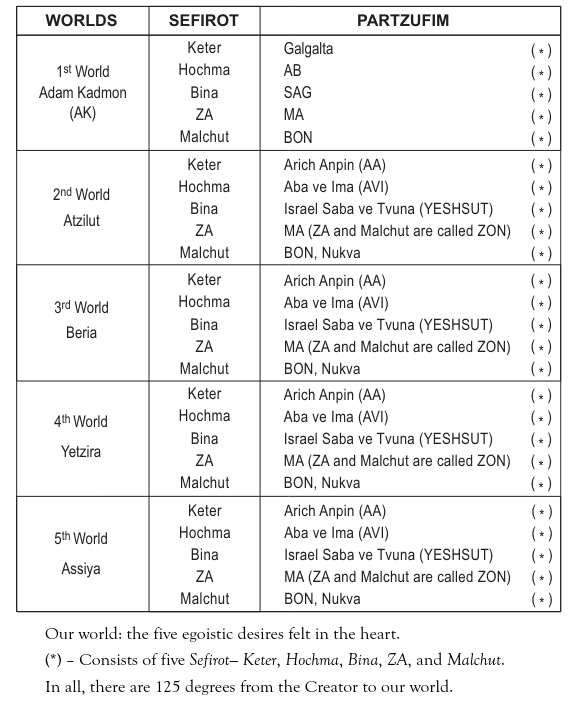
Worlds
Kabbalah studies the structure of the spiritual worlds. The purpose of these
worlds is to weaken the Creator’s signals (desires) so that we could understand
them with our egoism and realize them with our mind. In Hebrew, the word
for “world” is Olam (from the word Haalamah—meaning concealment), for
these worlds conceal and weaken the Creator’s Light to such an extent that
we can feel it.
Depending on everyone’s spiritual qualities, on the degree of one’s
attainment (complete egoism = our world, partial altruism = spiritual worlds),
we perceive the Creator or His Light differently at each of the 125 degrees. These
125 degrees amount to just ten, called “the ten Sefirot between the Creator and
us,” where every lower Sefira transmits less of the Creator’s Light, as perceived
by those at that degree. The lower the Sefira, the less of the Creator’s Light it lets
through to those that are below it.
SEFIROT
These are the names of the Sefirot: Keter, Hochma, Bina, Hesed, Gevura, Tifferet,
Netzah, Hod, Yesod, and Malchut. However, six of them are combined into one
Sefira, called Zeir Anpin, so in all there are five Sefirot: Keter, Hochma, Bina,
ZA, and Malchut. Also, ZA himself (ZA is usually considered a male Sefira) is
sometimes called Tifferet, since Tifferet is his main Sefira, absorbing within itself
the properties of all six Sefirot of ZA. Thus, the Creator created only five Sefirot:
Keter—the Creator’s desire to bestow delight upon us, Malchut;
Hochma—the pleasure itself, which the Creator wishes to bestow upon us;
Bina—passes the pleasure from Hochma to ZA;
ZA—accepts the pleasure from Bina and passes it to Malchut;
Malchut—receives the pleasure.
Malchut herself is the creature—the egoistic will to receive pleasure, to enjoy
the Creator’s Light. This desire is to enjoy the Creator’s Light or the Creator
(which is the same thing) is the essence of Malchut. We are parts of Malchut.
However, if we have only egoistic desires, we feel the Creator’s Light as pleasures
in our world. This is a micro dose of His Light. By correcting our desires
(properties), we can ascend the spiritual degrees of the Upper Worlds, and there
experience the Creator’s true delight.
According to the Thought of Creation, Malchut must receive the Light from
the four previous Sefirot, and delight in it. Hence, Malchut herself consists of five
parts: she receives the Light from the preceding Sefirot in four parts, and senses
it in the fifth.
All the Sefirot that precede Malchut (excluding Malchut) are similar to our
sensory organs, and Malchut is like the heart that receives from all organs: brain,
sight, hearing, smell, taste, and touch. The heart is Malchut, and the sensory
organs are the first nine Sefirot that precede Malchut. All of these parts of Malchut
are egoistic—they wish to receive the Light (pleasure) so as to enjoy it. With such
properties, Malchut cannot receive more than a micro dose of the Light of our
world, sensing the Creator in a manner called “this world.”
However, if Malchut, i.e., every one of us, were to receive desires (aspirations)
from Above to bestow delight upon the Creator to the same extent that we feel
the Creator bestowing upon us, with this property (desire), man would ascend
spiritually to a degree above our world. He would sense the Creator as spiritual
Light, altruistic pleasure and great knowledge, attainment of supernal thoughts
and the essence of existence
Malchut can receive the Light only in anti-egoistic desires. If such desires
appear in Malchut as a result of the realization that egoism is her enemy (with
the help of Kabbalah), to the extent of her hatred for it, Malchut can repel
the egoistic pleasures for the sake of spiritual perfection, i.e., similarity to the
Creator in her desire to please Him and act for His sake.
This ability to repel selfish reception of pleasure is called “a screen,” and
the repelled pleasure is called “Returning Light,” and the pleasure that comes to
Malchut is called “Direct Light.” It is precisely in the repelled pleasure, meaning
in the desire to bestow whole-heartedly, selflessly, that man can sense the
Creator’s Light and Supreme Knowledge.
Since Malchut (man’s egoism) has to repel pleasure from the five parts of her
egoism, the reflecting screen must also consist of five parts. Hence, it creates five
parts of the Returning Light. The five parts in Malchut are called by the names
of the Sefirot from which they receive. The five kinds of Direct Light are called
NRNHY: Nefesh, Ruach, Neshama, Haya and Yechida.
After Malchut reflects the Light (pleasure), she decides to receive it in order to
delight the Creator, because He wants Malchut to receive pleasure and feel Him.
The reflection of all the incoming pleasure is called Rosh (head). The partial
reception of the Light to the extent of one’s anti-egoistic powers is called Toch
Now let us clarify what is written in The Zohar: There are ten Sefirot: Keter
(K), Hochma (H), Bina (B), Hesed (H), Gevura (G), Tifferet (T), Netzah (N), Hod
(H), Yesod (Y), and Malchut (M). However, there are actually only five of them:
Keter (K), Hochma (H), Bina (B), Tifferet (T), and Malchut (M). This is because
Tifferet (alternatively called Zeir Anpin—ZA) consists of six Sefirot, from Hesed to
Yesod. Five Sefirot KHB-ZA-M created five Partzufim in each world. In the world
of Atzilut, these Partzufim are Arich Anpin (AA), Aba ve Ima (AVI), and Zeir Anpin
and Nukva (ZON). Keter is called AA; correspondingly, Hochma and Bina are
called AVI; and ZA (Tifferet) and Malchut are called ZON.
The essence of the seven days of creation lies in Partzufim ZA and Nukva of
the world of Atzilut, which consist of seven Sefirot: HGT-NHYM. And from the
description of creation it transpires how AVI (Hochma and Bina) beget ZON (all
of creation, including us) and elevate them to their final state during the 6,000
years. This is what The Book of Zohar tells us.
Rabbi Hizkiyah began his explanation of Nukva of the world of Atzilut
by clarifying the birth of ZON from Ima (Bina), called Elokim. That is why he
began his explanation with a rose, Nukva of ZA. At the utmost completion of
its development, Nukva of ZA is called Knesset Israel, the Assembly of Israel.
For Nukva consists of all the souls called Israel; hence, it is said that a rose is
Knesset Israel.
There are two states in a rose (Malchut). The lowest, initial, small state
(Katnut) is when Malchut consists only of Sefira Keter filled with the Light
Nefesh, while her other nine Sefirot are those that fell from the world of Atzilut
to the world of Beria. The other state of Nukva is mature, big, complete
(Gadlut), when her nine Sefirot ascend from the world of Beria back to the
world of Atzilut, and complete the full ten Sefirot of her Partzuf. Then, being
equal to her husband, Malchut ascends together with him to AVI and clothes
them, i.e., receives their Light.
The clothing of the lower, outer Partzuf onto the Upper, Inner One means
that the lower Partzuf attains a part of the Upper One, ascends to a Higher
spiritual level, and becomes in some way similar to the Upper Partzuf.
In that state, ZA is called Israel, from the letters LI (to me) and ROSH
(head), which signifies the state of Gadlut, while Nukva is called “the Assembly
of Israel,” for she accumulates all of the Light of her husband, ZA, and passes it
to the lower ones—the souls in the worlds BYA.
Nukva’s state of Katnut is called “a rose among thorns,” for nine of her lower
Sefirot in the Katnut state fell under the Parsa of the world of Atzilut, thereby
losing the Light of the world of Atzilut, and becoming as dry as thorns. And in
her Gadlut state, Nukva is simply called “a rose” or “the Assembly of Israel.” This
is why it is written, “there is a rose, and there is a rose.”
The color red designates the rose’s connection with the outer, impure forces,
which, because of this connection, can suck the strength (Light) from it. This is
because nine of her Sefirot are in exile below the world of Atzilut, in the world
of Beria, which may already contain impure forces. And the rose also has a color
white in its Sefira Keter, for her Sefira Keter is in the world of Atzilut, above the
Parsa, where there is no contact with the lower, impure forces. In other words,
there are two opposite states: perfection and its absence, Light and darkness.
It is therefore written that just as a rose among thorns is tinged with red
and white, so does the Assembly of Israel consist of judgment and mercy. This
shows that in Gadlut, when Malchut is called Knesset Israel, even though she
ascended to Bina and clothed her, she still retains the property of judgment, of
restriction—an attitude that’s tough and just, rather than compassionate. This
is so because she needs a screen (a force of resistance to her egoistic desires),
which, if available, enables Malchut to receive the Upper Light.
The law, judgment, or restriction does not allow for the reception of Light
in egoistic desires. The screen, the aspiration to oppose one’s egoistic desires,
repels the Upper Light (pleasure) back to its source, the Creator. The Light that
man sends back is called “Returning Light” or the “Light of Judgment.”
To the extent of the intensity of the reflective force (i.e., the force of resistance to
one’s will to receive), man is allowed to receive the ten Sefirot of the Upper Light
(called the Direct Light or the Light of Mercy) for the Creator’s sake, in precisely
these altruistic desires. And that is why, even in its complete state, the Assembly
of Israel consists of judgment and mercy, which corresponds to the red and
white colors of a rose among thorns
Ok, we'll stop here, but 2 things:
- we can see that the language of the Zohar is writting is a very compact way about specific spiritual state (which we just got a glimpse today) - and in the language of Kabbalah, we need much more words and descriptions - and this is what Baal HaSulam did with his commentary onf the Zohar, he gave us a unpacked version so that we can translate these states as actions of our soul, and to better understand what the Zohar meant he also wrote 4 introductions to the book of Zohar, so do not feel bad if you do not understand everything, we will get back to it but with more preparation and with time and persistance it will become so clear that you will feel the book deserve his name the book of Zohar - radiance - shining in our world.
- Meanwhile we need to remember what Baal HaSulam writes in the introduction of the Study of the Ten Sefirot:
Although they do not understand what they are learning, through the yearning and the great desire to understand what they are learning, they awaken upon themselves the Lights that surround their souls.
Baal HaSulam, Introduction to The Study of the Ten Sefirot
So it depends on the intention during the study and next week, the topic will actually be "Intention"