ALL THE ANSWERS ARE CORRECT!
Courses / Fundamentals of Kabbalah 2025/2026 / "Hevruta" - following Lesson 5. The spiritual force inherent in authentic Kabbalah books
"Hevruta" - following Lesson 5. The spiritual force inherent in authentic Kabbalah books
"Hevruta" - following Lesson 5. The spiritual force inherent in authentic Kabbalah books
Lesson content
Materials
"Fundamentals of the Wisdom of Kabbalah" Course Roadmap:
"Hevruta" - following Lesson 5:
The spiritual force inherent in authentic Kabbalah books.
The Language of Kabbalah - the Language of Roots and Branches.
Workshop
Let’s share our impressions from the previous lesson:
- What was the most memorable point for you in the last lesson?
- Which idea or insight touched or impressed you the most?
"The Widsom of Kabbalah mentions nothing of our corporeal world."
- Baal HaSulam,The Freedom
The Language of Kabbalah - the Language of Roots and Branches
"There is not an element of reality or an occurrence of reality in a lower world that you will not find its likeness in the world above it, as identical as two drops in a pond. And they are called “root and branch.” That means that the item in the lower world is deemed a branch of its pattern found in the higher world, which is the root of the lower element, as this is where that item in the lower world has been imprinted and made to be. That was the intention of our sages when they said, “You have not a blade of grass below that has not a fortune and a guard above that strikes it and tells it, ‘Grow’!”"
- Baal HaSulam, The Essence of the Wisdom of Kabbalah
“Thus, Kabbalists have found a set and annotated vocabulary sufficient to create an excellent spoken language. It enables them to converse with one another of the dealings in the spiritual roots in the upper worlds, by merely mentioning the lower, tangible branch in this world, which is well defined to our corporeal senses. The listeners understand the upper root to which this corporeal branch points because it is related to it, being its imprint.
- Baal HaSulam, The Essence of the Wisdom of Kabbalah
“We must remember that the entire wisdom of Kabbalah is founded on spiritual matters that do not take up time or space. They are not subject to change or absence and all the changes that are spoken of in this wisdom do not imply that the first form becomes absent and is replaced by a different form. The above change rather implies an additional form, while the first does not move from its place, as absence and change are corporeal conducts…
…It is difficult for beginners, for they perceive matters by means of corporeal boundaries of time, space, change and exchange. However, the authors only used those as signs to point to their upper roots.
For this reason, I will make an effort to give every word its spiritual identity, detached of space, time and change.
It is upon the readers to memorize the meaning of these words thoroughly, for it is impossible to repeat them every time.”
- Baal HaSulam, The Study of the Ten Sefirot, Part 1, Ch. 1, Inner Light
Workshop Question:
Why Baal HaSulam chose to open the Study of the Ten Sefirot with this particular introduction?
Because - [choose the correct answer]:
-
Kabbalistic books are full of examples taken from our world, and this can create confusion.
-
Since our words describe only the reality of this world, it is difficult for us to understand words that describe a different reality.
-
We do not know the connections between roots and branches.
Examples from the Kabbalah Dictionary
Baal HaSulam, The Study of the Ten Sefirot, Questions and Answers on the Meaning of Words:
What is “Creator” (Part 1, Inner Observation, 18)
The name "Creator" relates solely to the innovation, meaning the making of “existence from absence”, which is the substance of the vessels, defined as the “will to receive” in every essence. It was necessarily absent in His self prior to creation.
What is “Adhesion” (Part 1, Chap 1, Inner Light, 30)
It is equivalence of form that brings the spirituals closer and attaches them to one another, while disparity of form moves them away from one another.
What is “time” (The Part 1, Inner Observation, 34)
It is a certain sum of phases that cascade from one another and are mingled in one another by an order of cause and consequence, such as days, months, and years.
What is a “place” (Part 1, Inner Observation, 11)
The will to receive in the emanated being is the “place” for all the abundance and the light in it.
What is corporeality
Anything that is depicted and perceived by the five senses, or occupies place and time, is called “corporeality.”
Spirituality
The term “Spirituality” that is presented in books of Kabbalah means that it is devoid of any corporeal occurrences, meaning time, place, imagination, etc. Sometimes, it indicates only the upper light in the vessel, although a vessel is also spiritual in every sense.
Four Languages in the Wisdom of Kabbalah
-
The language of the Bible — its names and appellations.
-
The language of Halakha (laws) — very close in structure and style to the language of the Bible.
-
The language of legends (Aggadah) — far removed from the biblical style; it does not adhere to tangible reality. It uses unusual names and symbols and does not relate to concepts through the system of root and branch.
-
The language of Sefirot and Partzufim — the most precise and technical language used to describe spiritual structures.
"The Language of the Bible
This language has two advantages and one disadvantage. Its first advantage.
1st advantage: It is easy to understand, and even beginners in attainments immediately understand all that they need.
2nd advantage: It clarifies matters more extensively and deeply than all other languages.
One disadvantage: It cannot be used for discussing particular issues or connections of cause and consequence because every matter must be clarified in its fullest measure...
Also, the language of prayers and blessings is taken from the language of the Bible."
- Baal HaSulam “The Teaching of the Kabbalah and Its Essence"
The Language of the Bible
“In the beginning God created the heavens and the earth.”
This describes two forces at work:
-
the will to bestow, and
-
the will to receive (the ego).
The creature uses both forces together, not just one, in order to reach the level of the Creator.
"The Language of Halakha (Laws)
This language is taken entirely from the language of the Bible according to the roots of the laws presented there. It has one advantage over the Bible—it greatly elaborates on every matter and hence points to the upper roots more accurately.
However, its great disadvantage compared to the language of the Bible is that it is very difficult to understand."
- Baal HaSulam “The Teaching of the Kabbalah and Its Essence"
"The Language of Aggadah (Legends)
The language of legends is easy to understand through the allegories that perfectly fit the desired meaning. In superficial examination, it is even easier to understand than the language of the Bible. Yet, for complete understanding, it is a very difficult language as it does not confine itself to speaking in sequences of root and branch, but only in allegories and marvelous wit. However, it is very rich in resolving abstruse and odd concepts that concern the essence of the degree in its state, for itself, which cannot be explained in the languages of the Bible and laws."
- Baal HaSulam “The Teaching of the Kabbalah and Its Essence”
The language of the book of Zohar
“Rabbi Elazar went to see Rabbi Yosi, son of Rabbi Shimon, son of Lakunia, his father-in-law, and Rabbi Aba was with him. A man was driving their donkeys, meaning leading their donkeys…
…‘Driving’ means stinging, since it is an alias to the donkey driver because of his custom to sting the donkeys with a needle so they will walk faster. Rabbi Aba said, “Let us open the doors of Torah, for now is the time and the hour for our ways to be corrected.””
- The Book of Zohar with the Sulam [Ladder] Commentary, Introduction of the Book of Zohar, "The Donkey Driver," Item 74
The Language of the Wisdom of Kabbalah
"The language of Kabbalists is a language in the full sense of the word—very precise, both in terms of root and branch, and concerning cause and consequence. It has the unique merit of being able to express subtle details in this language without any limits. Also, through it, it is possible to approach the desired matter directly, without the need to connect it with what precedes it or follows it.
...However, it is almost impossible to attain it, except from a Kabbalist sage, and from a sage who understands with his own mind. This means that even one who understands the rest of the degrees from below upward and from above downward with his own mind, he will still not understand anything in this language until he receives it from a sage who has already received it from his teacher face to face."
- Baal HaSulam “The Teaching of the Kabbalah and Its Essence”
Video clip 1 >>
“So these four languages — all of them — are part of the wisdom of Kabbalah and of the attainment of the Creator. It is not that one language explains something through stories, another deals with history, another with psychology, and only the language of Kabbalah belongs to the hidden realm. No. All these languages speak about the revelation of the Creator to the created beings — only in different styles, levels, and aspects. They all describe what is hidden from us.”
— Rav Michael Laitman
Video clip 2 >>
“The tongue is not our physical tongue; it is not speech in the ordinary sense. It is rather a conduit — a channel through which we can connect. In the past, for example, we did not have the ability to communicate through radio waves and similar means, and now we do — so a new form of communication appeared.
Likewise, these four languages of communication in Kabbalah are not taken from technology, but from the understanding of the human soul and its connection to the spiritual world. Therefore, we express ourselves through four languages.
You could say that this stems from the four levels of coarseness of the will to receive — and I would say yes, yes.”
— Rav Michael Laitman
The Main Books of the Authentic Wisdom of Kabbalah
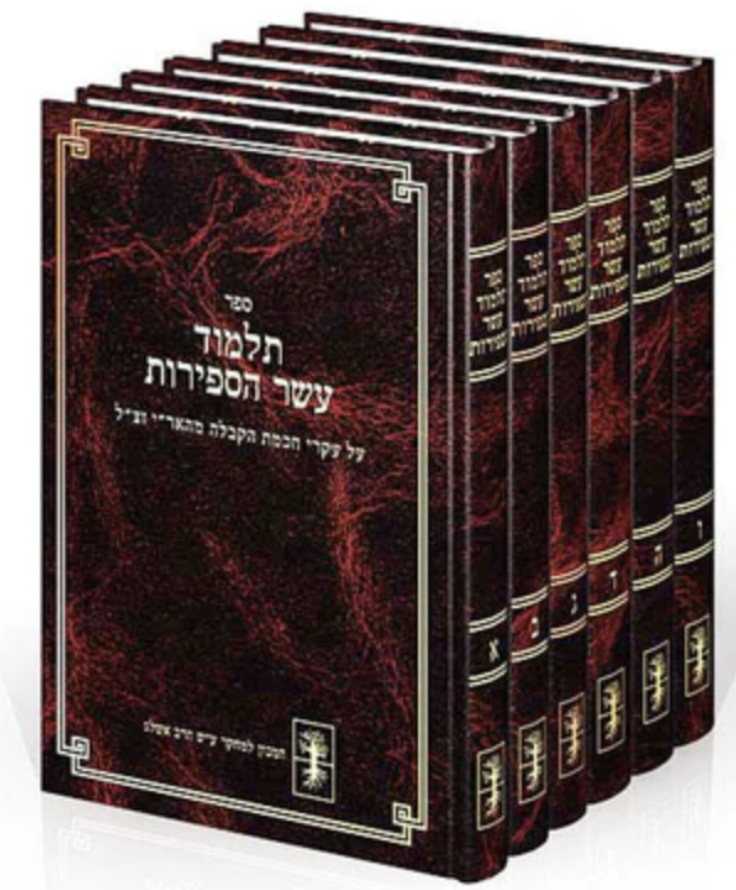
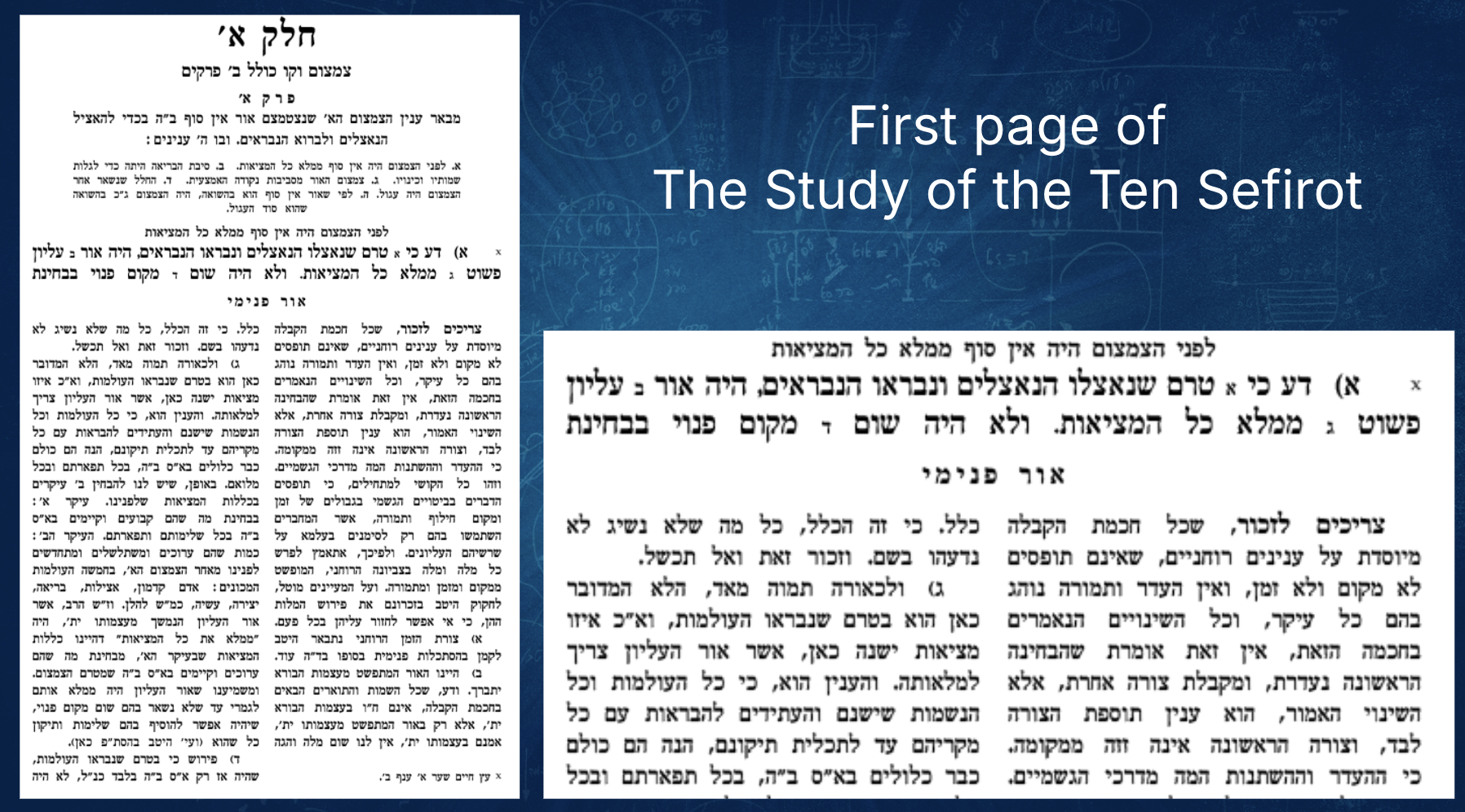
Baal HaSulam "Talmud Eser Sefirot" [The Study of the Ten Sefirot]
The Book of Zohar
Baal HaSulam "The Sulam [ladder] Commentary on The Book of Zohar"

"And I have named that commentary The Sulam (The Ladder) to show that the purpose of my commentary is as the role of any ladder: if you have an attic filled abundantly, then all you need is a ladder to reach it. And then, all the bounty in the world will be in your hands."
- Baal HaSulam, “Introduction to The Book of Zohar,” Item 58
The Writings оf RABASH
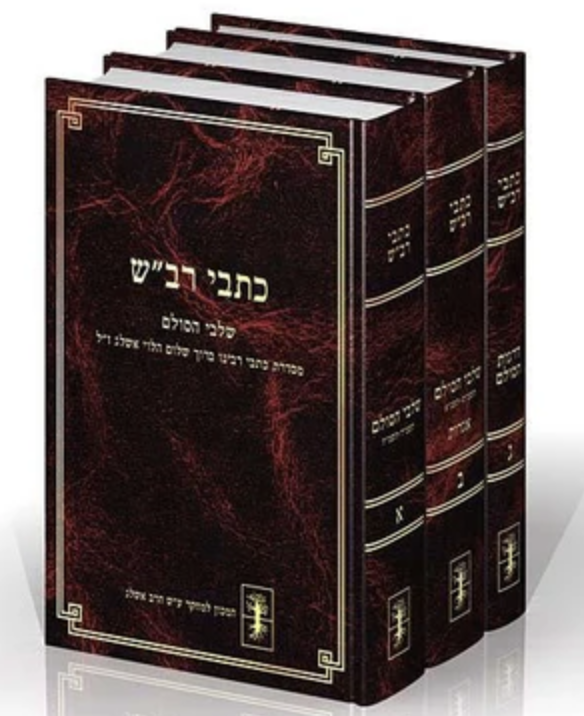
These books disclose the profound knowledge of human nature that the RABASH possessed, and take us on a journey to our own souls.
Bnei Baruch Kabbalah Book Store >> [use promo code: LIGHT]
(And also on Amazon)

NEXT LESSON TOPIC
Lesson 6 — Dec 21, 2025
History & Transmission of Kabbala
- Who is a Kabbalist?
- Key milestones in the development of Kabbalah.
- The connection between human history and spiritual evolution.
- How authentic Kabbalah is transmitted across generations.
Related Materials:
Baal HaSulam "The Teaching of the Kabbalah and Its Essence" >>