Hevruta - Following Lesson 11 - The Main Thing Is the Intention
None
A person must set the intention before studying Torah, to clarify the reason for which he is now engaging in Torah study. For every action must have a purpose, which is the reason for performing that action now. This is …
A person must set the intention before studying Torah, to clarify the reason for which he is now engaging in Torah study. For every action must have a purpose, which is the reason for performing that action now. This is as our sages said: “Prayer without intention is like a body without a soul.” Therefore, before going to study Torah, one must prepare the intention.
(Rabash, Article 12, “What Are Torah and Work in the Path of the Creator,” 1988)
The Torah with which we engage is in order to subdue the evil inclination. That is, to attain adhesion with the Creator, so that all of one’s actions will be solely for the sake of bestowal. In other words, by his own strength, a person has no possibility of having the power to go against his nature. For the matter of mind and heart, in which a person must be completed, he must receive assistance. And this assistance comes through the Torah, as our sages said: “I have created the evil inclination, I have created the Torah as a spice.” For by engaging in it, the light within it reforms them.
(Rabash, Article 12, “What Are Torah and Work in the Path of the Creator,” 1988)
A person must strive to make a great effort before going to study, so that his study will bear fruit and produce good results. That is, that the study will bring him the light of Torah, through which he will have the ability to be returned to good. Then, through the Torah, he becomes a “wise student” (Talmid Chacham). And what is a wise student? My teacher and father, may his memory be blessed, said: a student is one who learns from a wise person. That is, the Creator is called “Wise,” and the person who learns from Him is called “a student of the Wise.” And what should a person learn from the Creator? He said that a person must learn only one thing from the Creator. As is known, the Creator’s desire is only to bestow; likewise, a person must learn from Him to be one who bestows. This is called “a wise student.”
(Rabash, Article 12, “What Are Torah and Work in the Path of the Creator,” 1988)
A person must strive not to forget the goal during Torah study, that it should always be before his eyes, that he wants to receive from the study that the study will impart to him the greatness and importance of the Creator.
(Rabash, Article 29, “For Her Sake and Not for Her Sake,” 1986)
The matter of “Torah and work” means that one studies Torah in order that the Torah will bring him the light of Torah, through which he will have the ability to transform the vessels of reception so that they will be in order to bestow. With these vessels, he will merit adhesion with the Creator, which is called studying Torah for its own sake.
(Rabash, Article 12, “What Are Torah and Work in the Path of the Creator,” 1988)
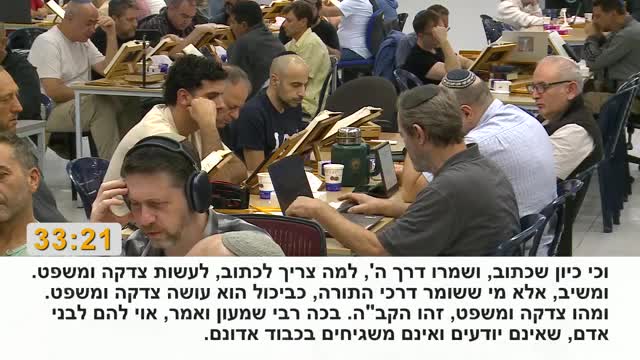
Clip Rav
(See Playlist)
Transcript
A request is what a person wants. That is called a request. He does not need to dress it in beautiful words or construct a sentence such as, "Please give me," or "Please do this for me." He does not need that. What he wants in his heart is the request. This is how it works and acts in spirituality: the inner desire in the heart.
The inner desire in his heart goes through all kinds of changes. At first, he wants pleasure. Then, through the study, the Surrounding Light shines, and through this Surrounding Light the heart already begins to change. When the heart changes, it begins to ask to be corrected to some extent according to the Surrounding Light, according to the qualities it senses in the Surrounding Light, according to what the Light is.
Accordingly, the Surrounding Light shines even more if the heart asks it for corrections, and then the heart asks for even more corrections. This continues according to the measure of a person's investment in the correct study, with the correct intention. He relates to it with increasing precision and sees and feels how his heart is directed each time toward a truer goal.
Each time, the Surrounding Light shines more, and he grasps more of the inner essence of the Light, and accordingly his desire changes. It works as a closed cycle: the Light improves the desire, and the desire draws more Light.
This continues until he truly begins to want, together with reception for himself, also something in order to bestow. This state is already called Lo Lishma, from which one can reach Lishma.
When he reaches Lishma, he crosses the Machsom and receives a Masach. Then his turning toward the Surrounding Light, where the Surrounding Light is already called a higher degree, "the AHP of the Upper One," becomes more directed, and his connection with the Upper One becomes tighter.
But it still follows the same principle: there is the person's desire and there is the Light before the desire. This Light constantly corrects the desire, through illumination from afar, illumination from nearby, inner illumination, and through all the different ways in which the Light relates to the desire, the desire changes.
There is nothing else in reality besides these two: the Light and the desire.
The intellect, the mind, experience, everything a person has received in addition to the vessel of sensation, are given so that he can determine his attitude toward the vessel and toward the Light.
Therefore, to the extent that a person can use the means at his disposal to assist the action of the Light upon the desire, and if he does so, then by this he determines his participation in the general process of correction that the Creator carries out.
Apart from this participation in the correction of the vessel by the Surrounding Light, there is nothing else for a person to do. All other things simply do not count, are not registered, and do not act in reality.
Reality, as it is, develops from State One to State Three through State Two. It already unfolds according to its nature, according to its structure, according to the way the Light acts within the vessels. There is nothing new in this, nor are there things that can suddenly emerge and appear in entirely different forms.
No. There is a vessel, there is Light, and the Light acts within the vessel according to its nature, awakening clear and predetermined responses within the vessel.
The whole matter is the pace.
What does that mean? If a person adds his participation to the action of the Light within the vessel, by this he determines his advancement. By this he determines his sensation and his attitude toward the process. This is called justifying the actions of the Creator, being a "righteous one."
The extent to which he justifies and participates in this process is called his spiritual degree.
If I agree with the Creator in sixty percent of His process, this means, for example, that I am on degree sixty out of one hundred degrees, if we were to measure it that way. If I agree with Him ninety percent, then I am on degree ninety out of one hundred.
To the extent that I act together with Him, to the extent that the horse becomes equal in its actions with its rider, this is called a person's spiritual degree: the measure of participation, the measure of adhesion.
Therefore, we need to pay attention only to this, to this one point, and to see everything else as things that come as help, or as an obstacle that is also help.
We need only to strengthen this point: to participate in the process of correction that the Upper Light, the Creator, carries out upon us.
This is called, "Behind and before You have formed me" [Achor ve-Kedem Tzartani], and it is in this that we need to adhere together.
Adhesion is in the process that has been established for us.
Discussion + Q&A
How can we clarify and improve the intention during the study?