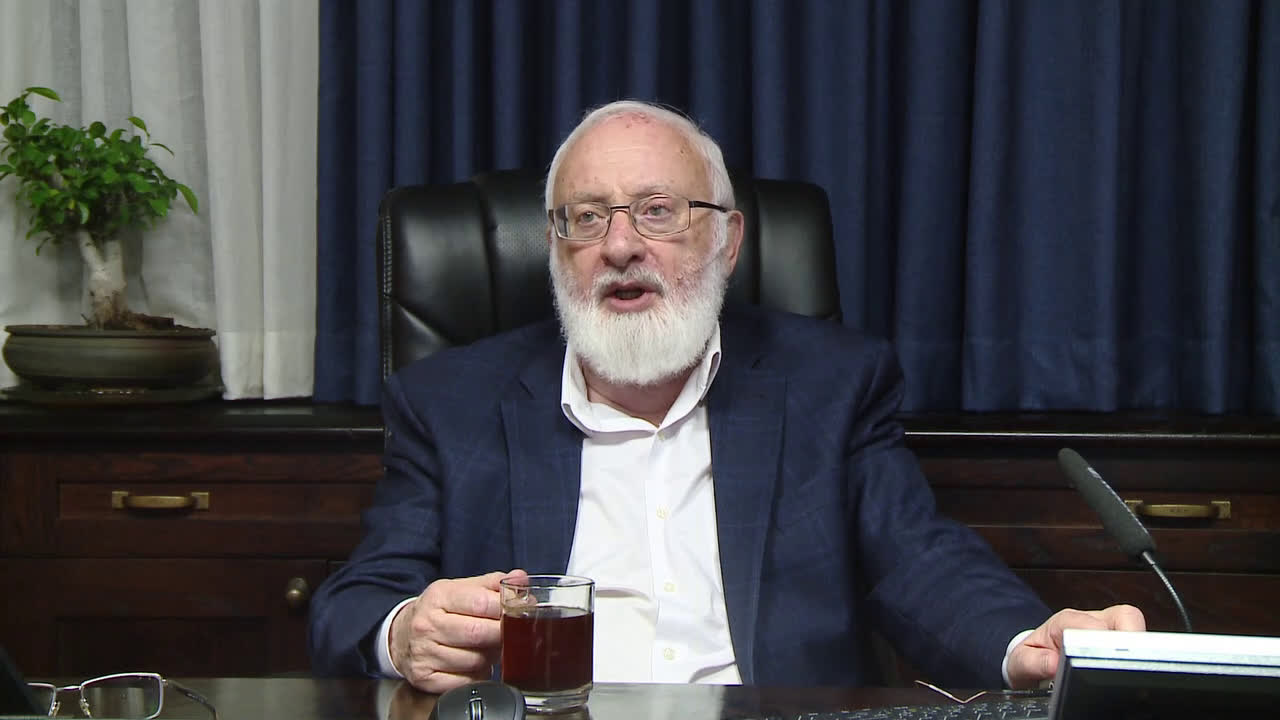
Hevruta - Following Lesson 10 - Playing the Next Degree
None
Playing the Next DegreeIn Kabbalah, "Mizchak" (משחק) means both "game" and "play," but it is much more than simply pretending. It is an inner effort to approach the next spiritual degree, to make ourselves similar to a state that we …
Playing the Next Degree
In Kabbalah, "Mizchak" (משחק) means both "game" and "play," but it is much more than simply pretending. It is an inner effort to approach the next spiritual degree, to make ourselves similar to a state that we have not yet attained.
We remember that Baal HaSulam explains that the Light coming from the next degree is called the Surrounding Light, "Or Makif" in Hebrew. So playing the next degree is a very precise effort to make ourselves similar to this future state that we need to achieve.
This inner work is done in the group, in the Ten, where we play the next degree of connection, love, and spiritual advancement.
We try to do things that may not yet seem possible, but we still want to try. It is like a child who plays at flying a plane. He does not have a plane, does not know how to fly, and is not actually flying, but through the game he is already building something inside himself.
In the same way, through this play we build the inner structure, the Kli, the inner vessel that will help us achieve the next degree.
So let’s watch the clip, and afterwards discuss what this state of playing really means.
Clip Rav - Playing the Next Degree (14 min)
Video Link:
https://kabbalah.academy/en/videos/playing-the-next-degree-in-kabbalah/
Transcript:
We see that in the wisdom of Kabbalah there are definitions that are not quite the same as the ones we use in this world. Playing is essentially a transition. It is truly a game. It is like a cat that wants to jump: it looks, checks itself, considers how it is going to jump, and then jumps. So all this preparation, everything it imagines, everything it does, is all a game. It is playing out what it is about to do.
Playing is how we picture the next state. Therefore, our entire life should actually be a game in which we aspire to connection between us, and within that connection to reveal the Creator, to reach the purpose of our existence, eternal and complete life. All of this is attained through playing. Just as in this life we play when we are children and thereby grow, so it is in our spiritual life. Only there, we have to take this game into our own hands, understand what is happening, and learn how to participate in the game in partnership with the Creator. Without playing, we cannot draw closer to Him and become His partners. And to the extent that we picture ourselves drawing closer to the Creator, we begin to understand what playing actually is.
It follows that we must constantly play: a person with himself, a person with the group, a person with the Creator. And the Creator also plays with Leviathan, meaning with the whole of creation, as it is written, "This Leviathan You have created to play with." In this way, through playing, we reach a state called the "Feast of Leviathan," where all of us, all of humanity, sit together around the great table together with the Creator, and we are at the Feast of Leviathan. We eat it, the Leviathan that we played with, meaning that we used it in order to advance and become more and more Adam, human, similar to the Creator. And when we become similar to the Creator, we and He become truly incorporated as one, and the whole Leviathan, the whole of creation, is used by us correctly. This is called the Feast of Leviathan, the end of correction.
Therefore, each time we only need to picture the matter more and more correctly. The main thing in correctly picturing our world and our life is that we constantly find ourselves in confusion, and we see how the world itself is confused. From being in such a state, we repeatedly begin from zero, from a form of confusion in which we have nothing left. If I want to be connected to the source of creation, to the purpose of creation, to hold onto an anchor, a rope, or something that can save me along the way, it is possible only if I am connected with the group. Because through the group I have a connection with the Creator.
Therefore, when I wake up in the morning, for example, I sometimes receive questions such as: What should I do when I wake up confused, wanting nothing, wanting to leave everything, wanting to continue sleeping, and so on? This is the correct state. This is exactly how it should be, and it will not become habitual. If it becomes habitual that I jump up and run toward some spiritual work, then it is not me, but someone awakening me from Above. I always value those states in which I can barely get up, I am foggy, I do not know who I am or what I am, where I am, or what I need to do.
From such states, from the fog and disconnection, I slowly begin to think, as in that story of the Baal Shem Tov, who asked his attendant, his student: If you do not know what to say, say "Aleph, Bet." And through this, little by little, from afar, he begins to awaken, recover, and arrive at adhesion.
This is how it is with us. Every morning we have to awaken as though from death, from complete disconnection, and renew everything. Therefore, when I wake up and have no connection with anything in life, like an animal, barely even able to picture myself as an animal, I am very happy that I am in such a state, because everything I had before has truly been taken away from me: my connection with the Creator, the study, everything. And I begin only by remembering that I need to discover who I am, what I am, what my life is, where I am directed, and with whom I need to be connected.
Then I remember that all these things depend on some Creator, but the Creator is far away. Who is He at all? What is He? I have no feeling toward Him and no direction of thought toward Him. But then I remember that He is found in the center of the ten. Then, what is the ten? Who is the ten? And in this way I begin to feel my way and seemingly gather them before me, to picture them, until I arrive at this kind of work first in the mind and afterward in the feeling: that ultimately, all I need is to find a connection with them, and through them I am connected with the Creator and with the world.
Therefore, all my effort, my entire "I," is measured by the extent to which I am in the ten, rely on them, and afterward even by how I bestow upon them, and through them upon the Creator, and through Him upon this entire world. Then the whole picture awakens before me: how I exist in reality, where I am, and how I influence all of reality through the ten, through the Creator, and through the world. All of this is realized in the ten, in my small group.
Therefore, this disconnection that I receive from the moment I wake up, when I see myself completely disconnected from everything, truly less than an animal, is for my benefit. In this way I renew my attitude toward creation, toward the Creator, and most importantly toward the ten.
This is how we should try to see these states. Therefore, there is no bad state and no good state in a person. It is always a new state. The main thing is that there should be a certain atmosphere in the group that will not allow a person to fall completely. He may feel disconnected, abandoned, as though he is being carried by some current that takes him away from everything, from life itself and so on. It is fine for all this to exist and influence us, but we must nevertheless prepare in advance some connection with the ten, with the group, so that I feel myself returning to it.
Through it, the small system of Adam HaRishon, in the lowest form, in the corporeal form that has been given to me, I have something to hold onto. It is like a baby holding onto a beloved toy. He clings to it, and we know that he calms down when he has it in his hand. For months he grows in this way, unable to let it go. This is also how we advance, because only through this do we find our direction and awaken correctly to life each time.
This may happen when we literally wake up from sleep, or it may happen in the middle of the day when we lose our connection with spirituality because of various external influences, at work, in the street, in the family, and afterward we return to it. Therefore, when we discover ourselves confused and disconnected from the essence of life and from the purpose of life, it is in order for us to establish a new connection in the group and through it with the Creator.
It is good to have as many such disconnections and reconnections as possible. As the Baal Shem Tov related, this happened to him many times.
Let's Put It Into Practice
Choose the person next to you on Zoom, the next camera, or simply the next name you see.
Take turns telling that person all the most beautiful things you can possibly say about them.
Do not hold back. Be generous, exaggerated, and creative. Speak about their qualities, personality, presence, abilities, appearance, anything wonderful you can imagine.
It does not matter whether you know the person well or whether everything feels completely true.
Go 100%. Build the most beautiful image of that person you possibly can.
Afterwards, we will discuss it together. This will give us some material to open up the concept of "game" in Kabbalah.
Sharing Round
What we just said may have been exaggerated, imagined, or not completely "true." But the feeling it created can still be very real.
So let's do a round:
What did you feel while giving or receiving these words? Did something change in the way you saw the other person, even for a moment?
A person must reveal the love that is in his heart toward the friends, because through this revelation he causes his friend's heart to awaken toward the friends, so that the friends, too, will feel that each and every one is engaging in love of friends. The benefit of this is that through it, he receives a stronger power to act in love of friends with greater strength and vigor, since the power of love of each and every one is included in his friend.
It follows that instead of having one power to engage in love of friends, if the society consists of ten friends, he is now included in ten powers that understand the necessity of engaging in love of friends. However, if each one does not reveal to the society that he is engaging in love of friends, he lacks the power of the society, since it is very difficult to judge one's friend favorably, and each one thinks of himself as the righteous one, that only he is engaging in love of friends. It follows that he has only a small power with which to work in love of others. It therefore follows that specifically this work should be done openly, and not in concealment.
(Rabash, Article No. 2, "Concerning Love of Friends," 1984)
We see that there is one thing that is common to everyone, namely the matter of one's mood, as they said, "If there is concern in a person's heart, he should speak of it to others." For when it comes to having an uplifted spirit, neither wealth nor wisdom, and the like, will help a person.
Rather, specifically one person can help another when he sees that he is in a state of lowliness. As it is written, "A prisoner cannot free himself from prison," but specifically his friend can bring him to an uplifted spirit.
That is, his friend raises him from the state he is in to a state of vitality. He begins once again to acquire strength and confidence in life and abundance, and begins to feel as though his goal is now close to him.
It follows that each and every one must pay attention and think about how he can help his friend and bring him to an uplifted spirit. For in the matter of one's mood, each one can find in his friend a place of deficiency that he can fill.
(Rabash, Article No. 4, "They Helped Every One His Friend," 1984)
Q&A