Lesson 21. The Thought of Creation
The Thought of Creation · Light and Vessel · The Four Phases of the Will to Receive
- The Thought of Creation
- Light and Vessel
- The Four Phases of the Will to Receive
Lesson 21. The Thought of Creation
Selected Excerpts from "Preface to the Wisdom of Kabbalah" by Baal HaSulam
1) ...The thought of creation was to delight the created beings in accord with His abundant generosity. For this reason, a great desire and craving to receive His abundance was imprinted in the souls.
This is so because the will to receive is the vessel for the measure of pleasure in the abundance, since the measure and strength of the will to receive the abundance precisely corresponds to the measure of pleasure and delight in the abundance. And they are so connected that they are indivisible, except in what they relate to: The pleasure is related to the abundance, and the great desire to receive the abundance is related to the receiving created being.
These two necessarily extend from the Creator. However, they should be divided in the above-mentioned manner: The abundance comes from His self, extending existence from existence, and the will to receive included there is the root of the created beings. This means that it is the root of initiation, that is, emergence existence from absence, since there is certainly no form of will to receive in His self.
Hence, it is considered that the above-mentioned will to receive is the whole substance of creation from beginning to end. Thus, all the created beings, all their innumerable instances and conducts that have appeared and will appear, are but measures and various values of the will to receive. All that exists in those created beings, that is, all that is received in the will to receive imprinted in them, extends from His self, existence from existence. It is not at all a new creation, existence from absence, since it is not new at all. Rather, it extends from His Endlessness existence from existence.
2) And know that these are the light and vessel that we discern in the upper worlds. They necessarily come tied together and cascade together degree by degree. And the extent to which the degrees descend from the light of His face and depart from Him is the extent of the materialization of the will to receive contained in the abundance.
We could also state the contrary: To the extent that the will to receive in the abundance materializes, it descends degree by degree, as written below, to the lowest of all places, where the will to receive is fully materialized. This place is called “the world of Assiya,” the will to receive is considered “man’s body,” and the abundance one receives is considered the measure of “vitality in that body.”
It is similar in other creatures in this world. Thus, the only difference between the upper worlds and this world is that as long as the will to receive incorporated in His abundance has not fully materialized, it is regarded as still being in the spiritual worlds, above this world. Once the will to receive has fully materialized, it is regarded as being in this world.
4) The reason why the will to receive must cascade by the four above-mentioned discernments in ABYA [Atzilut, Beria, Yetzira, Assiya] is that there is a great rule concerning the vessels: The expansion of the light and its departure make the vessel fit for its task. This means that as long as the vessel has not been separated from its light, it is included in the light and is annulled within it like a candle before a torch.
This annulment is because they are completely opposite from one another, on opposite ends. This is so because the light extends from His self, existence from existence. From the perspective of the thought of creation in Ein Sof [Infinity], it is all toward bestowal and there is no trace of a will to receive in it. Its opposite is the vessel, the great will to receive that abundance, and is the root of the innovated created being, in which there is no bestowal whatsoever.
Hence, when they are bound together, the will to receive is annulled in the light within it, and can determine its form only once the light has departed from it once. Following the departure of the light from it, it begins to crave it, and this craving properly determines and sets the shape of the will to receive. Subsequently, when the light dresses in it once more, it is regarded as two separate matters: vessel and light, or body and life. Observe closely, for this is most profound.
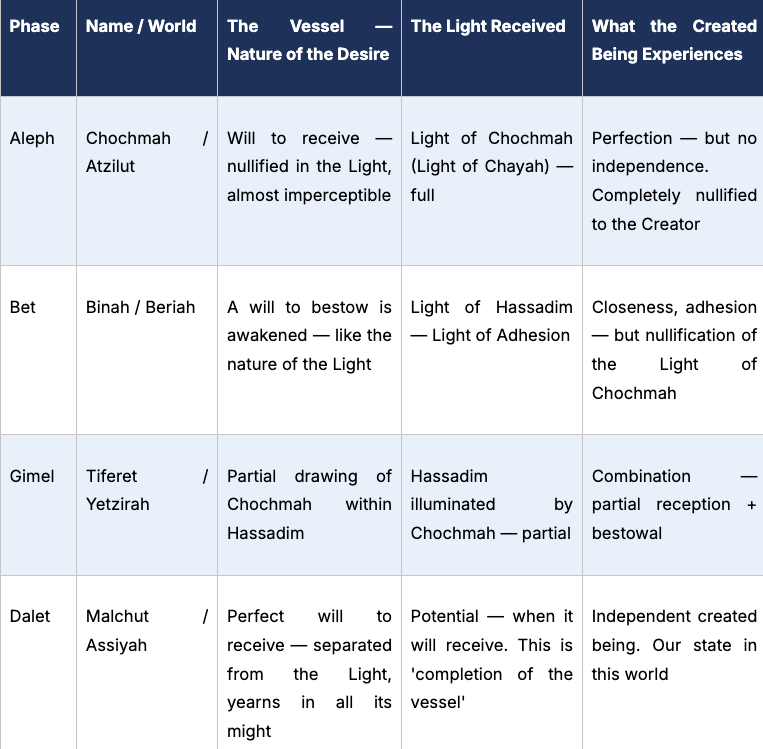
5) Hence, the four phases in the name HaVaYaH, called Hochma, Bina, Tifferet, Malchut, are required. Phase one, called Hochma, is indeed the whole of the emanated being, light and vessel. In it is the great will to receive with all the light included in it, called “light of Hochma” or “light of Haya,” as it is all the light of Hayim [life] in the emanated being, dressed in its vessel. However, this phase one is regarded as all light, and the vessel in it is barely noticeable as it is mingled with the light and annulled in it as a candle in a torch.
Following it comes phase two, since at its end, the vessel of Hochma intensifies in equivalence of form with the upper light in it. This means that a desire to bestow upon the Emanator awakens in it, according to the nature of the light within it, which is entirely to bestow.
Then, using this desire that has awakened in it, a new light extends to it from the Emanator, called “light of Hassadim.” As a result, it becomes almost entirely separated from the light of Hochma that the Emanator imprinted in it, since the light of Hochma can only be received in its own vessel—a desire to receive that has grown to its fullest measure.
Thus, the light and vessel in phase two are utterly different from those in phase one, since the vessel in it is the desire to bestow. The light within it is considered light of Hassadim, a light that stems from the adhesion of the emanated being in the Emanator, as the desire to bestow causes it equivalence of form with the Emanator, and in spirituality, equivalence of form is adhesion.
Next follows phase three, since once the light in the emanated being has diminished into light of Hassadim without any Hochma, and it is known that light of Hochma is the essence of the emanated being, hence, at the end of phase two, it awakened and drew into it a measure of light of Hochma to shine within its light of Hassadim. This awakening re-extended a certain measure of the will to receive, which forms a new vessel called phase three, or Tifferet. And the light in it is called “light of Hassadim in illumination of Hochma,” since the majority of this light is light of Hassadim, and its lesser part is light of Hochma.
Following it came phase four, since the vessel of phase three, too, awakened at its end to draw the complete light of Hochma, as it was in phase one. Thus, this awakening is considered “craving” in the measure of the will to receive in phase one and exceeds it since now it has already been separated from that light, as the light of Hochma is no longer clothed in it but craves it. Thus, the form of the will to receive has been fully determined, since the vessel is determined following the expansion of the light and its departure from there. Later, when it returns, it will receive the light once more. It turns out that the vessel precedes the light, and this is why this phase four is considered the completion of the vessel, and it is called Malchut [Kingship].
The Table of Four Phases
11) Now you can understand the real difference between spirituality and corporeality: Anything that contains a complete desire to receive, in all its aspects, which is phase four, is considered “corporeal.” This is what exists in all the elements of reality before us in this world. Conversely, anything above this great measure of desire to receive is considered “spirituality.” These are the worlds ABYA, which are above this world, they and the whole reality within them.
Now you can see that the whole issue of ascents and descents described in the upper worlds does not relate to an imaginary place, but only to the four phases in the will to receive. The farther it is from phase four, the higher it is considered to be. And conversely, the closer it is to phase four, the lower it is considered to be.