All Kabbalistic writings describe the relationship between the Creator and the created beings.
Courses / Fundamentals of Kabbalah 2025/2026 / Lesson 6. The development of the wisdom of Kabbalah over the generations
Lesson 6. The development of the wisdom of Kabbalah over the generations
Lesson 6. The development of the wisdom of Kabbalah over the generations
In this lesson, we will explore how the wisdom of Kabbalah has been transmitted across generations. The chain of great Kabbalists — the unique souls who shaped the path of Kabbalah and passed its wisdom forward. The role of each generation in revealing and advancing spiritual understanding
Lesson content
Materials
- How did the wisdom of Kabbalah develop throughout history, and is there a connection between our collective spiritual development and various historical events?
- How is the wisdom of Kabbalah transmitted from generation to generation?
Lesson 6.
The development of the wisdom of Kabbalah over the generations
SLIDE 2
Summary from the previous lessons
SLIDE 3
The Will to Receive
- Desire is the force that defines and shapes the development of humanity.
- Desire is willpower, desire to receive pleasure and delight.
- The desire to receive itself is neither good nor bad; it is the substance of creation. Good or bad is measured only in relation to the use we make of the desire to receive—for our own benefit or for the benefit of others.
- Using the desire to receive for one's own benefit is called "intention in order to receive". Using the desire to receive for the benefit of others is called "intention to bestow".
- Every person in our world works according to the intention in order to receive for one's own benefit. In order to change that intention, we must learn the wisdom of Kabbalah.
- Correction—changing the use of the desire to receive, from the intention in order to receive to the intention in order to bestow.
- The "pleasure extinguishes the desire" principle—the mechanism that causes the desire to develop: every time the desire is filled with pleasure, the desire fades, the pleasure is extinguished, and as a result a new, greater desire arises.
SLIDE 4
The Perception of Reality
- The desire to receive is the internal software that manages our “perception of reality” mechanism. We see what we want to see. In order to perceive spiritual reality, we must change the software according to which we perceive reality, that is, the desire to receive.
- According to the law of “similarity of form,” in order to perceive the spiritual reality, we must develop within the desire to receive sensitivity to spirituality, an intention to bestow, to give.
SLIDE 5
Root and Branch Law
According to the law of root and branch, every branch in this world has its own unique root from which it descends into reality.
Root = cause
Branch = consequence
World of roots = the spiritual world
World of branches = the physical world
SLIDE 6
Root and Branch Law
The language of the branches that appears in the Kabbalah books describes the spiritual roots while using the names of the "branches" in our world.
When we come across words that are familiar to us from everyday life in the books of Kabbalah, we must remember that they are directed to the spiritual roots and not to what is happening in our world.
SLIDE 7
Kabbalah Books
SLIDE 8
Kabbalah Books
Kabbalists describe all states as they cascade from the highest level of attachment to the Creator down to this world.
SLIDE 9
Kabbalah Books
All spiritual states, or “worlds” (from the word he'elem — concealment), are sensed within our desires, which resemble, to varying degrees, the higher laws of Nature or the Creator (Nature = Creator).
SLIDE 10
Avraham is the foundation of the point in the heart
SLIDE 11
"Abraham, son of Terach, went by and saw them building the city and the tower ... but they loathed his words ... They wished to speak each other’s language but they did not know each other’s language. What did they do? They each took his sword and fought one another to death. Indeed, half the world died there by the sword."
- Chapters of Rabbi Eliezar, Chapter 24
SLIDE 12
"At forty years of age, Abraham came to know his Maker. …He began to call out to the whole world, to alert them that there is one God to the whole world and that He is the One to be served. He would call out, wandering from town to town and from kingdom to kingdom, [...] Finally, tens of thousands assembled around him, and they are the people of the house of Abraham."
- Rambam, Mishneh Torah
SLIDE 13
“Love your neighbor as yourself.” All the things you want others to do for you, do them to your brothers … This is the law that Abraham Our Father established and the way of mercy in which he behaved, giving food and drinks to passersby and accompanying them."
- Rambam, Mishneh Torah, ch.14
SLIDE 14
"Through his complete work with great love, Abraham worked and imparted upon us a root of holiness so we, too, will be able to walk in his ways, to serve the Creator with love. This is the meaning of “descendant of Abraham, who loves Me.” He wishes to say that Abraham had sowed this love for all the people in the world."
- Noam Elimelech, Devarim
SLIDE 15
The Book of Zohar - Rabbi Shimon bar Yochai (RASHBI)
SLIDE 16
The ARI
SLIDE 17
Rav Yehuda Ashlag—Baal HaSulam

SLIDE 18
About the writings of Baal Hasulam
SLIDE 19
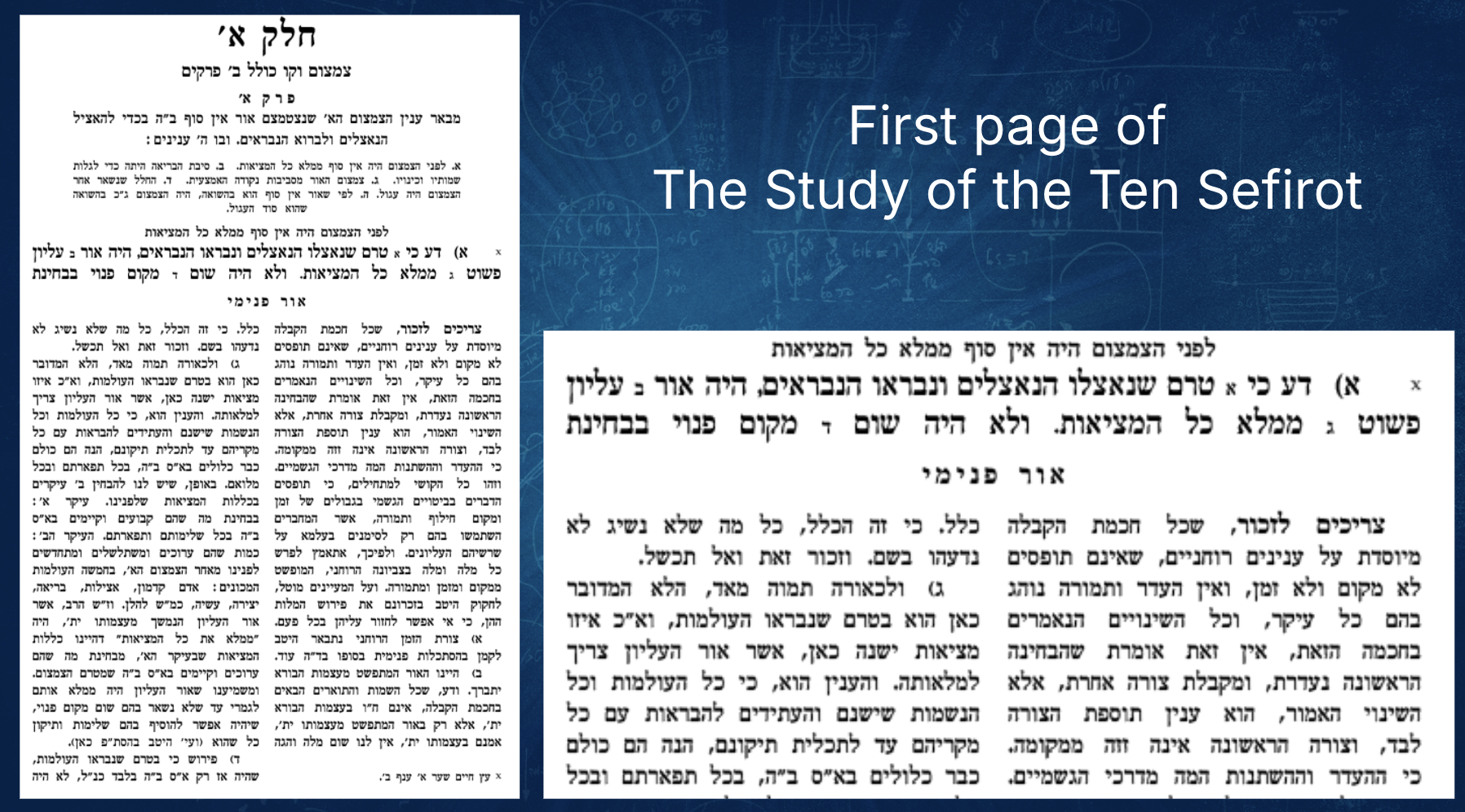
The Study of the Ten Sefirot
A foundational book in the study of the wisdom of Kabbalah.

SLIDE 20
First page of The Study of the Ten Sefirot
SLIDE 21
The Sulam [ladder] Commentary on The Book of Zohar“
The Book of Zohar” is studied after Baal HaSulam’s articles “Introduction to The Book of Zohar” and “Preface to the Wisdom of Kabbalah.”

SLIDE 22
Rav Baruch Shalom Ha-Levi Ashlag—Rabash

SLIDE 23
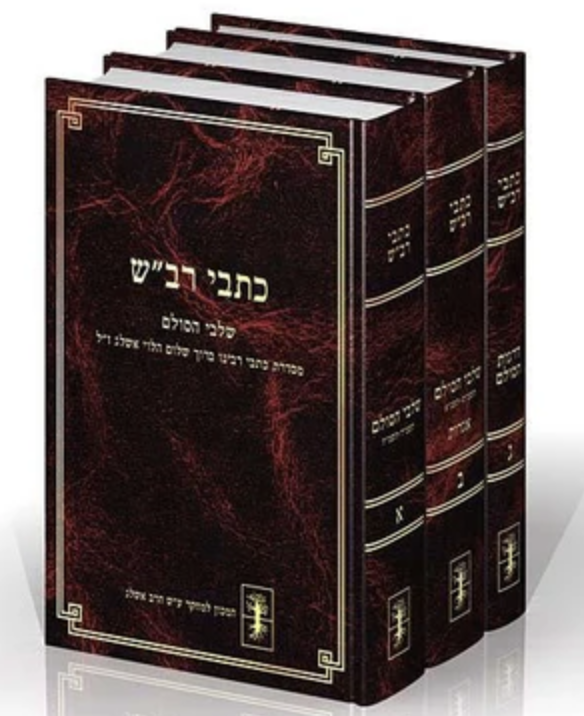
The Writings оf RABASH
These books reveal RABASH’s deep understanding of human nature and guide us on a journey into our own souls.
SLIDE 24
"You lack nothing but to go out to a field that the Lord has blessed, and collect all those flaccid organs that have drooped from your soul, and join them into a single body.In that complete body, the Creator will instill His Shechina incessantly, and the fountain of intelligence and high streams of light will be as a never ending fountain."
- Baal HaSulam, "Letter No. 4"